



By Sanjana Bandi
Jun 11, 2026
$112.6 million donation creates Nick Howley College of Engineering and Computing
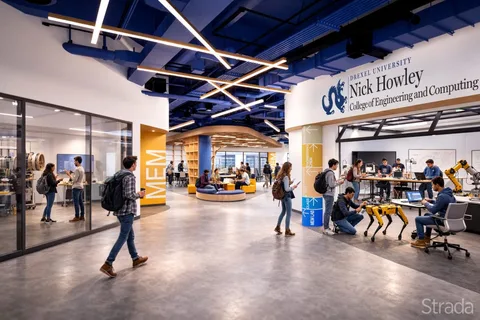
The Howley Foundation has gifted $112.6 million dollars to Drexel University, establishing the largest donation in the college’s history. In recognition of the donation, the College of Engineering and Computing — to be created through the merger of the College of Engineering, Informatics and Computing, and Biomedical Engineering in Fall 2026 — will be titled the Nick Howley College of Engineering and Computing, or Howley College. The merger will create the largest college within the university, and according to Drexel, “more than 5,000 students will pursue their academic career in one or more of the College’s 60 undergraduate and graduate degree programs, including its newly launched undergraduate degree in artificial intelligence and machine learning.” Of the total donation, $36 million will be allocated to renovate 3101 Market Street into upgraded laboratories and learning spaces for engineering students, to be named the Howley Family Immersive Learning Center. Additionally, 10,000 square feet at the intersection of 32nd and Market Street will be converted into the Walter N. Howley Jr. Innovation Garage, a collaborative space that will “showcase the work of Drexel’s engineering and computing student organizations in dedicated bays.” The remaining $76 million will fund need-based scholarships for students enrolled in Howley College. Merit-based scholarships will also be awarded to students from select schools in Philadelphia and Cleveland through the Howley College Scholars program, which was established by Howley in 2022. These scholarships are available to students throughout the university, not exclusively those in engineering and computing. Currently, the program provides full scholarships to graduates of seven Philadelphia-area high schools. An endowment will also be set in place to “strengthen its national reputation and continue to attract exceptionally talented students and faculty.” “This investment is a powerful affirmation of Drexel’s strength and leadership in fields where innovation and impact are deeply intertwined,” Drexel President Antonio Merlo said in a statement sent out to the university. “It will not only bring excitement and a new look to our campus, but it will also provide generations of students with access to state-of-the-art facilities, as well as set them on course for a transformational educational experience at Drexel.” The Howley Foundation is an educational nonprofit led by Drexel alumnus Nick Howley, a 1975 mechanical engineering graduate, along with his wife, Lorie Howley, and his daughter, Meg Howley, who earned a master’s degree in psychology in 2010. The family’s ties to the university span three generations: Howley’s father, Walter Howley, attended Drexel after World War II, graduating with a degree in engineering in 1951, and several of Howley’s relatives currently attend the university. “Most of my eight siblings live in the [Philadelphia] area,” Howley told The Triangle in an interview. “I have a number of both nephews and nieces going to Drexel for undergraduate and graduate school ... I have a lot of family connections, but most specifically my dad, myself and my daughter.” After graduating from Drexel, Howley earned an MBA from Harvard Business School. He later founded TransDigm Group, an aircraft component manufacturer, and Perimeter Solutions, a producer of firefighting products, both listed on the New York Stock Exchange. Expanding educational opportunity has long been a central focus of the Howley Family Foundation. Earlier this year, Howley made headlines by donating $74 million to St. Joseph’s Preparatory School in Philadelphia, his alma mater, the largest gift ever made to a Catholic school. “We run a good-sized foundation, Howley Foundation — cleverly named,” Howley shared. “We focus almost exclusively on education for students that have the ability but not the economic means.” “My wife and I feel very strongly that the best way for people to get what I’ll call economic and social mobility is a quality education,” he said. “I’m one of eight, and that’s what my parents always thought. It’s the only thing they thought they could do for us.” In addition to the deep-running family connection, Howley is supportive of Drexel’s experiential education model. “We think Drexel uniquely fits. The co-op and work study program is particularly good for the kind of students that we tend to support ... very bluntly, they need a job, and Drexel prepares them very, very well for that.” Beyond his personal ties to the university, Howley said the merger of Drexel’s three engineering-focused colleges “made it even more attractive to me.” “You get a bigger entity,” he said. “It makes sense given the reality of today’s marketplace.” He also voiced support for Drexel’s transition from quarters to semesters. “The transition will be tricky, but I think it makes good sense. [Drexel] will still primarily be a co-op school.” When it came to coordinating the multi-million-dollar gift, Howley remarked on how closely he worked with the Drexel administration. “[President] Merlo was very involved. As was Laura Turner, they were both very involved. [Merlo] was right in the middle of it, and I thought he did a great job.” Turner, a member of President Merlo’s Cabinet, is the Senior Vice President at the Office of Institutional Advancement. Students across the university were surprised by the large donation. “I think a gift of this scale is insane,” Nyah Patel, a third-year biomedical engineering major, told The Triangle. Patel also wonders when students will begin to see the effects of the investment. “If they’re starting construction in spring 2027, it probably won’t be until at least a year later when resources become available,” she said. “Either way, I hope investments from this donation are put to good use and make lasting benefits for students.” “My initial reaction was complete shock,” said Bobby Saunders, a third-year civil engineering major. “This is a huge amount of money, and the engineering program at Drexel honestly needs it.” “Many of our labs are in serious disrepair. Many times, labs have been modified or cancelled due to equipment failures. I was happy to see that a soil and concrete analysis lab is being added to 3101 Market Street. That is definitely something we need.” Saunders added that the expansion of 3101 Market Street could also benefit students outside of mechanical engineering. “3101 Market Street currently mainly houses mechanical engineering labs, so it will be exciting to see other majors use the space,” he continued. “Also, having a flight simulator on campus sounds cool.” Beyond the flight simulator and soil and concrete analysis lab, the planned additions include a robotics facility, a jet engine lab, and wet labs for engineering applications. Saunders admitted that he initially had reservations about merging the engineering, biomedical engineering, and computing schools. “The three schools function differently and use different campus spaces,” he said. “But the funding makes me feel confident about the merger, and hopeful that the funds will integrate the three schools into a consistent unit.” Michael Davis, a third-year Computing and Security Technology student, shared similar concerns. “As a CCI student, I was worried that the merger would just make life harder, but this implies that there will hopefully be more resources and planning around the College of Engineering and Computing,” he said. “I understand that the computing school requires less physical space and resources than the engineering schools, but I have always felt that Drexel does not offer a lot of designated workspace to computing students and I wonder if this will change things.” Howley’s donation surpasses Bennett LeBow’s $45 million gift that spurred the construction of LeBow Hall for the College of Business in 2013. Both Patel and Saunders drew comparisons between the two and what the gift could mean for Drexel’s future identity. “The College of Engineering and Computing being renamed to Howley College is going to put the recognition on a LeBow-status,” Patel said. “I’m curious to see how it’s going to become part of the school’s identity.” “I could imagine ‘Howley’ being used to refer to the College of Engineering and Computing, similar to how ‘LeBow’ refers to the business college,” Saunders commented. “I don’t necessarily have any problems with that.” Still, Saunders acknowledged having mixed feelings about the imminent name change. “On one hand, engineering is Drexel’s flagship program, the most well-known, and has the largest number of students,” he said. “Part of me feels like the new name could distract from this reputation. On the other hand, the university should take what it can get — and with a donation this huge, I feel like the new name is more than a fair deal.” Ultimately, Saunders said he hopes the investment helps bring broader recognition to the university. “Drexel engineering students — and most of the engineering faculty — are passionate and hardworking,” he said. “I hope this funding allows more people to recognize our drive. I know Drexel’s engineering program is great, but I want people nationwide to recognize the quality of Drexel’s engineering education as well.” For Howley, this investment gives back to the institution that helped shape his career. “My experience at Drexel was great,” he said. “I came in as not a great student, and frankly, I became a very good student. I graduated at the top of my class and ended up at Harvard. Drexel gave me a good basis for much of what I did throughout my life.” Howley is also scheduled to deliver the keynote address at the College of Engineering commencement ceremony on Friday, June 12.
Source: Drexel Triangle