



By @MEXC_Official
May 28, 2026
Atlas Humanoid Robot Goes Viral for Stunning Human-Like Movement
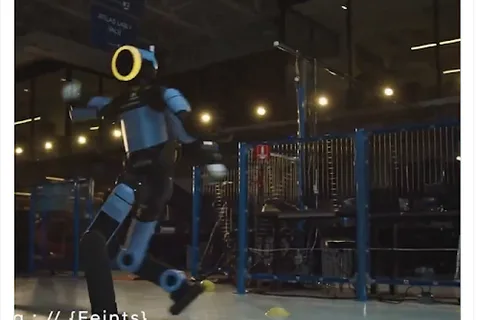
The Atlas humanoid robot developed by Boston Dynamics has drawn widespread attention online after new demonstrations showcased its remarkably fluid, human-like movement despite weighing nearly 200 pounds. The robotic system, known for its advanced mobility and balance capabilities, continues to push the boundaries of modern robotics, sparking renewed debate about the future of humanoid machines in real-world environments. The viral demonstrations were widely discussed across tech communities and later referenced in reporting associated with Cointelegraph and distributed through HOKANEWS. Source: XPost Atlas Robot Captures Global Attention The Atlas humanoid robot has become one of the most recognizable examples of advanced robotics, with recent footage showing it performing complex, coordinated movements that closely resemble human agility. Despite its heavy frame—estimated at nearly 200 pounds—the robot demonstrates precise control, balance, and responsiveness. Engineering Breakthrough in Humanoid Robotics Developed by Boston Dynamics, Atlas represents a major engineering achievement in robotics, combining mechanical design, artificial intelligence, and advanced motion control systems. Atlas Robot is designed to navigate complex environments, perform dynamic movements, and adapt to unpredictable physical conditions. Human-Like Movement Raises New Questions The smooth and lifelike motion of Atlas has sparked discussions about how close robotics is to achieving truly human-equivalent physical behavior. Robotics Industry Enters New Phase Experts suggest that humanoid robotics is entering a new phase where machines are no longer limited to rigid or repetitive motion but can instead perform dynamic physical tasks. Advanced Balance and Coordination Systems Atlas relies on advanced sensors, real-time processing, and machine learning algorithms to maintain balance and execute complex movements. Applications in Real-World Environments Potential applications for humanoid robots include industrial logistics, warehouse automation, disaster response, and hazardous environment operations. AI and Robotics Convergence The development of systems like Atlas Robot reflects the growing convergence between artificial intelligence and physical robotics. Social Media Drives Viral Interest Videos of Atlas performing agile movements have circulated widely online, contributing to its viral status and public fascination. Robotics Competes with Human Dexterity The ability of humanoid robots to replicate human motion is becoming a key benchmark in robotics research and development. Safety and Ethical Considerations As humanoid robots become more capable, questions around safety, control, and ethical deployment are increasingly important. Industrial Automation Potential Expands Companies are exploring how humanoid robots could enhance productivity in environments that require human-like movement. Boston Dynamics Continues Innovation Boston Dynamics remains at the forefront of robotics innovation, consistently demonstrating breakthroughs in mobility and control systems. Public Fascination with Humanoid Machines The lifelike appearance and motion of Atlas contribute to growing public interest in the future of humanoid AI systems. Conclusion The Atlas humanoid robot continues to capture global attention as its fluid, human-like movement challenges traditional perceptions of robotics. Despite weighing nearly 200 pounds, the system demonstrates extraordinary agility and precision, highlighting significant progress in robotics and artificial intelligence. As development continues, Atlas Robot stands as a symbol of how rapidly humanoid machines are evolving toward real-world functionality.
Source: mexc.com