



By News Desk
May 23, 2026
Chinese robot companies are moving beyond factory production lines and entering the home chores mark..
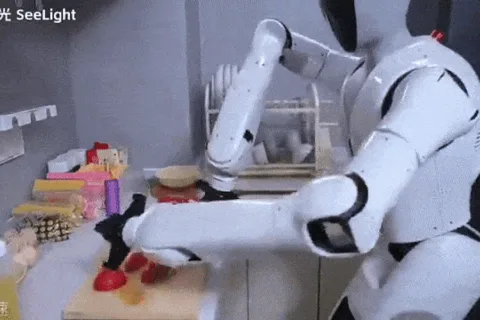
Chinese robot companies are moving beyond factory production lines and entering the home chores market in earnest. According to the South China Morning Post (SCMP) on the 21st local time, Chinese robot company GigaAI unveiled China's first general-purpose home humanoid robot, SeeLight S1, in cooperation with the Hubei Humanoid Robot Innovation Center and the Hubei Humanoid Robot Industry Alliance. According to Changjiang Daily, GigaAI CEO Ju Jeong plans to begin a free trial deployment of the robot in homes in Wuhan in the first half of 2027. The released demonstration video shows the robot preparing vegetables and cooking eggs, as well as operating a washing machine, hanging out laundry, and tidying a bed. It also includes a safety control feature that stops the robot immediately if it detects a pet or a child. Unlike conventional factory-style humanoid robots, S1 is designed around an embodied AI model that lets it understand tasks on its own and autonomously plan how to carry them out. That sets it apart from many humanoid robots currently used on factory production lines, which rely on hard-coded algorithms and preset routines. GigaAI will first run a pilot program with 100 robots in residential complexes for workers in advanced industries, then expand testing to ordinary households in Wuhan next year. It will focus on collecting real-world data from homes with elderly people, children, and pets. GigaAI aims to cut hardware prices to 100,000 yuan, or less than half the current level, by June 2027. CEO Ju said, "We expect major progress in the commercialization of home robots and embodied AI implementation technologies by 2028." According to Chinese market research firm LeadLeo Research Institute, the global home robot market was estimated at about $41 billion last year and is expected to grow by an average of 20% annually through 2027. Robot vacuums currently dominate the market, while humanoid home robots have yet to reach full-scale commercialization. Experts say the home humanoid market has strong growth potential, but it also faces many challenges. Guo Renjie, CEO of Zeroth Robotics, said, "Unlike industrial settings, home environments are not standardized, so robots must respond to changing conditions every day." As a result, major Chinese robot makers are speeding up pilot deployments of their products and verification work to secure data from real-life environments. Shenzhen-based robot company Won Robotics recently said it signed a project contract worth 45 million yuan to collect lifestyle data related to housework, elder care, and retail environments. Using its self-developed Wonlo H1 robot, the company plans to gather data on frequently performed tasks such as organizing, cleaning, and storing and retrieving items inside homes.
Source: 매일경제