



By @IntEngineering, Sujita Sinha
May 29, 2026
From heavy machinery to embodied AI: How Zvalley is building the operating layer for industrial robotics
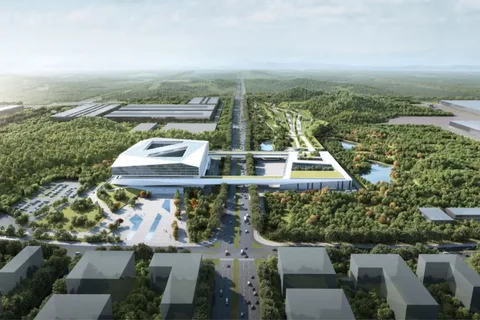
Incubated by Zoomlion, a construction machinery and equipment manufacturer, Zvalley is bringing robotics, AI agents, and industrial data together through RobotOps, a platform designed to move embodied intelligence from the lab to the factory floor. At Hannover Messe, one of the world’s most important industrial technology gatherings, attendees walking past the Zoomlion booth were not just seeing the latest evolution of a global construction machinery company. They were also seeing the emergence of Zvalley, the Zoomlion subsidiary charged with helping define the company’s future in artificial intelligence, robotics, and industrial software. “You can think of Zoomlion as the industrial foundation, and Zvalley as the digital intelligence empowering its development,” said Zeng Guang, PhD, General Manager of Zvalley. For Zvalley, Hannover Messe marked a notable milestone. It was the company’s first overseas exhibition, and its global debut came at a moment when industrial companies around the world are trying to understand what artificial intelligence will actually look like inside factories, logistics systems, and heavy industrial environments. Founded in 2018 and incubated by Zoomlion, Zvalley describes itself as a high-tech AI industrial internet company. Its mission is to reshape heavy industry through AI and robotics, not as a distant research project, but as a practical engineering challenge. The company’s work spans the Internet of Things, cloud computing, big data, artificial intelligence, and embodied AI robotics, with an emphasis on turning emerging technologies into systems that can function in real-world industrial environments. “Our position in the industrial AI landscape is that of a bridge between AI and advanced manufacturing,” Dr. Zeng said. “We are developing intelligent robots tailored for core environments, alongside the AI-native cloud platform required to power embodied intelligence at scale.” That bridge is important because the industrial robotics market is entering a new phase. For years, much of the attention around humanoid robots and embodied AI has focused on prototypes, demonstrations, and hardware capability. Zvalley is focused on the harder next step: making these systems deployable, repeatable, and manageable across complex industrial settings. The company’s answer is RobotOps, a full-stack platform that made its global debut at Hannover Messe. Built to connect software development, data pipelines, and AI agent operations, RobotOps is designed to address what Zvalley sees as a fundamental challenge for robotics: bringing what works in the lab out into the real world. “RobotOps was built to solve the robotics industry’s most critical bottleneck: bridging the gap between a lab prototype and scaled industrial deployment,” Dr. Zeng said. In practical terms, that means tackling several problems at once. Industrial robotics development remains expensive and slow. Models trained in simulation often struggle when they encounter unpredictable real-world environments. High-quality training data can be difficult and costly to acquire. And once robots are deployed, many operators still lack a unified system to manage the full lifecycle of software updates, data feedback, agent behavior, and fleet operations. Zvalley argues that these are not isolated technical issues, but structural problems in how robotics has historically been developed. Dr. Zeng points to a fragmented technology ecosystem, limited access to real-world industrial data, and the siloing of software, hardware, and AI agents as barriers that have slowed the industry’s progress. RobotOps brings three operating layers together: DevOps, DataOps, and AgentOps. DevOps supports software development, testing, deployment, and operations. DataOps manages data collection, annotation, governance, and application. AgentOps handles the orchestration of AI agents and multi-agent collaboration. For an industrial operator, the goal is straightforward: make robots easier to develop, deploy, and manage at scale. “When these three pillars form a closed loop, they create a one-stop engineering ecosystem that lowers the technical barrier to entry, accelerates deployment, and simplifies the management of robot fleets at scale,” Dr. Zeng said. Zvalley’s connection to Zoomlion gives the company a different starting point than many robotics startups. Zoomlion is one of the world’s largest construction machinery companies, with operations in more than 180 countries and decades of real-world industrial experience. For Zvalley, that heritage provides both technical resources and access to industrial testing environments that are difficult to replicate. “That heritage is our deepest competitive advantage,” Dr. Zeng said. “It gives us two distinct strengths that pure-play startups simply cannot replicate: technological depth and access to real-world testing environments at industrial scale.” On the technology side, Zvalley has developed capabilities across both robotics hardware and software. The company says it has developed multiple humanoid robot models, some nearing mass production, along with proprietary controllers, drivers, joint modules, and an Embodied AI Foundation Model capable of tasks such as dual-arm coordinated grasping. On the scenario side, Zvalley is able to deploy and test robots directly inside Zoomlion Smart City, where humanoid robots are already being used for tasks including factory inspection and logistics sorting. The smart factories there provide a feedback loop from actual industrial environments, helping refine robot perception, decision-making, and control. “We build robotics with an industrial mindset, working from the ground up within real operational environments,” Dr. Zeng said. At Hannover Messe, Zvalley demonstrated embodied intelligence and logistics sorting on the show floor. For the company, those demonstrations were meant to show that the technology has moved beyond the purely experimental stage. “The live demonstration at Hannover Messe marked a significant milestone: embodied intelligence has officially entered the industrial-grade practical stage,” Dr. Zeng said. “Motion control, environmental adaptability, autonomous decision-making, and multi-agent collaboration can all meet the basic requirements for industrial applications.” A major part of that progress, according to Zvalley, comes from the integration of Zoomlion’s operational data into RobotOps. Decades of industrial knowledge are being used to train robot perception, decision-making, and control models, allowing robots to learn from both equipment logic and human expertise. The platform is also designed to help robots work reliably across different environments and scenarios. RobotOps includes four core modules: a basic tool platform for cloud-edge integration and remote upgrades; an imitation learning platform that converts expert operational data into AI training assets; a reinforcement learning platform for autonomous exploration and sim-to-real transfer; and a task orchestration platform with zero-code drag-and-drop tools, OTA deployment, and compatibility across bipedal, quadrupedal, and wheeled robots. Together, these modules are intended to reduce the adaptation cost that often slows robotics deployments. Rather than treating every factory, task, or robot form factor as a separate engineering project, Zvalley wants RobotOps to provide a common foundation for deployment. The company’s global ambitions are also being supported by its work with AWS. At Hannover Messe, Zvalley presented in the manufacturing theater alongside AWS, highlighting a partnership that extends RobotOps through AWS cloud infrastructure. Commercially, the partnership gives Zvalley a path to deploy internationally through AWS’s global infrastructure and ecosystem. “This partnership is a significant accelerator for us,” Dr. Zeng said, adding that it helps Zvalley “reach overseas clients and partners more effectively” while reducing the cost of global deployment and services. The response at Hannover Messe also offered Zvalley a view into how global industrial markets are thinking about AI and robotics. According to Dr. Zeng, visitors were less focused on robots as standalone hardware and more interested in full-lifecycle engineering platforms that could support real deployment. “The focus is no longer solely on robot hardware,” he said. “The market now places far greater emphasis on full-lifecycle engineering platforms, with genuine recognition of the core value that practical deployment tools like RobotOps provide.” Zvalley also saw strong demand for robotics that can integrate directly into operational environments, as well as interest in open collaboration and standardized technology ecosystems. That aligns with the company’s longer-term vision for RobotOps as a foundational infrastructure layer for embodied intelligence. Over the next five years, Zvalley expects RobotOps to evolve into a full-lifecycle management system that integrates data, software, and agent workflows across multiple industries. “In 2026, we will achieve mass production at the hundreds of units scale and begin commercial sales,” Dr. Zeng said. “By 2027, we will reach thousands of units, accelerating expansion to external customers.” Within three years, Zvalley says it aims to reach annual production capacity of 10,000 units for its Z-series robots, while building an ecosystem of more than 100 partners across system integration, application development, and research. That vision reflects a broader shift in industrial AI. The next stage of robotics will not be defined by a single humanoid prototype or isolated automation breakthrough. It will depend on platforms that can manage the messy, ongoing work of data, software, agents, hardware, and real-world operations. For Zvalley, the opportunity is to bring those pieces together through the industrial scale of Zoomlion and the software infrastructure of RobotOps. As Dr. Zeng put it, Zvalley is not simply building robots. It is building “the AI-native cloud platform required to power embodied intelligence at scale.”
Source: Interesting Engineering