



By Emily Dreyfuss
May 22, 2026
How Stanford sold its soul to Silicon Valley
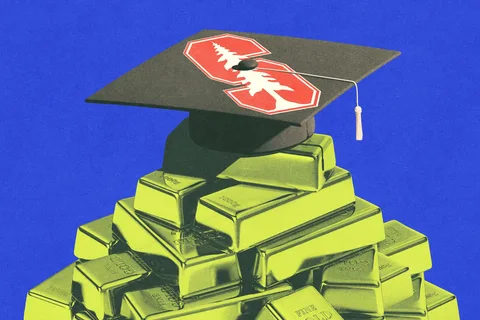
Theo Baker was still a teenager when he took down the president of Stanford University. And he hadn’t even meant to become a journalist. Baker had dreamed of going to Stanford since he was a wee nerd of 7, obsessed with coding and technology. He showed up at 17 to study computer science — the kid who’d built his first website in elementary school, now inside what he came to see as the world’s most powerful and secretive startup incubator disguised as an institution of learning. That made him exactly the kind of freshman Silicon Valley’s talent scouts circle. Within weeks, Baker was being courted to join what he calls the “Stanford inside Stanford,” a parallel college experience comprised of mansion parties and venture money, open only to the freshmen anointed as future founders. Its inner workings include an invite-only, uncredited seminar run by a Silicon Valley CEO called “How to Rule the World” — where simply knowing the class existed was itself a status symbol, a sign you were, as one student told Baker, “rule-adjacent.” You exist in this parallel reality, this bizarro world in which you, the teenager, are the product. But on a whim, Baker had also signed up for the student newspaper. What was supposed to be a hobby to honor his recently deceased grandfather became something else. By the end of freshman year, his reporting at The Stanford Daily had forced the resignation of then-President Marc Tessier-Lavigne over allegations of research misconduct, and won Baker a George Polk Award, making him the youngest journalist ever to receive one. And along the way, the same elite circles that had been trying to pluck him kept revealing themselves: the mansion parties, the VCs throwing millions at 18-year-olds, the kids learning they could fake a demo and keep going. The deeper Baker got into reporting, the more he saw what lay underneath. You are so valuable that venture capitalists have to get their hooks into you as early as possible. This week, Baker’s book “How to Rule the World: An Education in Power at Stanford University” — named after that secret seminar — came out to rave reviews. It also drew some criticism from folks who can’t get past the fact that Baker’s parents are themselves powerful journalists: Susan Glasser, a columnist at The New Yorker, and Peter Baker, a star White House correspondent at The New York Times. The “nepo baby” critique has been lobbed at Baker before (and, for what it’s worth, it’s been sent my way once or twice as well as the daughter of a famous actor). As my conversation with him shows, Baker is what happens when journalism is in the air you breathe your whole life. Was it wise of him to choose journalism over computer science and a Silicon Valley path gilded in gold? Well, the book has already been optioned for a movie — so perhaps the Stanford machine worked for Baker despite his dogged attempts to reveal and cut out the rot he found at the university’s core. This week on PST, I sit down with Baker to talk about the Stanford power machine, how it influences so much in our local culture and the wider world, and why, despite it all, he loves the place. The following conversation has been edited for clarity. You grew up in Washington, D.C. What drew you to Stanford? I remember when I was 7 years old, the image that really sold me was seeing these kids in Stanford T-shirts with their flip-flops and their shorts, lounging in the shade of a palm tree, resting against a self-driving car they had just built. And it was like: This is the place where everything is happening. This is where the future is being made. It’s so cool and laid-back and chill and brilliant and inventive. Stanford does have so many of those attributes. It’s just that in its quest for perfection, its need to present the very best-appearing version of itself to the world, a hell of a lot of bad things have been swept under the rug. This is really the goal of the book; I want to bring you along with me into this weird inner world that breeds so much innovation, but at the same time allows for fraud to seep in on all sides. Your book describes what you call a “Stanford inside Stanford.” What is that? Stanford professes this sort of singular identity, but it has become this sprawling institution. It has a budget higher than 116 countries. And there’s really not that much in common between an English lit major and one of these computer science kids who’s in the “Stanford inside Stanford,” where you’re one of the few being feted and offered “pre-idea funding” because you are so valuable that venture capitalists have to get their hooks into you as early as possible. These are kids who are going to their first college parties. At the same time, from the moment they step foot on campus, they are being pursued doggedly by people who want to profit off of them. You include a glossary of insider vocabulary. What does that language tell us about the place? You have to learn how to speak the lingo. You want to call something bad, you call it “anti-signal” because it’s all about signal-to-noise ratio. You want to be a “builder,” not a “wantapreneur.” One of the phrases in the glossary is “The plucked.” Who are they? As someone said to me one day, it’s sort of like you’re plucked from the crowd, and you come into a world that you never knew existed, and you can never go back. It’s a system that rewards exclusivity, that teaches kids how to get ahead at any cost. Once you have been tapped on the shoulder, you exist in this parallel reality, this sort of bizarro world in which you, the teenager, are the product. Who decides which freshmen get plucked? There’s this whole system of people whose entire job it is to root out the true builders from the wantapreneurs, to figure out who is actually worthy of being thrown millions of dollars. But the problem is that they’re not doing it based on talent or merit alone. Mostly, it’s your connections. It’s whether you’ve found the right access point. And there are a few different clubs on campus that relate to this. One is Treehacks, the school hackathon that I joined, which turns out to be a pipeline directly into the maelstrom of Silicon Valley. And of course, the most insider version of this is the secret class called “How to Rule the World.” This isn’t even a real class, right? There’s no course credit? There’s no course credit. It’s not officially sanctioned. What it is, is more like a Skull and Bones (opens in new tab) for the aspiring tech elite. Even knowing that it exists is a status symbol among the most insider of the insider kids, because it is this hyper-secret, hyper-exclusive 12-person-a-year seminar where you have to be tapped on the shoulder by someone already in the class to be worthy of an interview in this cloak-and-dagger admissions process with the Silicon Valley CEO named Justin who has styled himself as a professor. It’s a system that rewards exclusivity, that teaches kids how to get ahead at any cost. And at the same time, it’s a scam. It’s really a networking scheme because this professor just wants to get in with the teenagers like everyone else. You arrived wanting to be part of all this. How did you get noticed? At Stanford, you have to break in quickly. That was the thing I was always told, that if you don’t make your name within a few weeks of freshman year you’re not going to get entrance into this clique where you can be wined and dined every night of the year by a VC, where you all text the same billionaires for advice, and you call them by their first names. I wanted to be in the thick of things. I was one of maybe half a dozen freshmen to skip through the intro sequence and start right at CS 107, which is Stanford’s “weeder” class, the one that separates the true computer science majors from everyone else. The most rewarding thing I did during my tech side of freshman year was to join Treehacks, which is the largest college hackathon in the world. The collection of kids who are selected to run Treehacks are probably the most brilliant and inventive kids I’ve ever known. At the same time, Treehacks is also how I started to witness a lot of the corruption firsthand and see what happens when you give teenagers too much money with no oversight and no jurisdiction in terms of what they can or can’t do. At the same time, you were also making a name for yourself as a student journalist. By the end of freshman year, you’d won a George Polk Award for reporting that helped force Stanford’s president, Marc Tessier-Lavigne, to resign over flaws in his scientific research. What did you learn about how Stanford protects its image? As I began reporting this story, Marc Tessier-Lavigne hired Cooley, one of the largest law firms in Silicon Valley, and specifically Stephen Neal, who had represented Charles Keating Jr. and Elizabeth Holmes in the past. Marc Tessier-Lavigne, through Stephen Neal, attempted repeatedly to stop the reporting that I was doing. He also began sending out missives to the faculty about how my reporting was “breathtakingly outrageous” and “replete with falsehoods.” This is how the next Elizabeth Holmes or the next Sam Bankman-Fried is being created right now on this campus. Yet by the end of the year, as I report for the first time in this book, his own board of trustees unanimously voted to oust him over his conduct related to these allegations of research misconduct. You said earlier that Stanford is always trying to present the very best-appearing version of itself to the world. How does the president’s story play into that? The Marc Tessier-Lavigne story is very much a part of the story that I’m telling with the students, the bright-eyed freshmen, learning how to get ahead in Silicon Valley. If you hand a kid millions of dollars because they’ve overpromised on something, and then they don’t deliver on something, but they learn that they can fake a demo and keep going and no one’s going to call them on it, it spirals from there. This is how the next Elizabeth Holmes or the next Sam Bankman-Fried is being created right now on this campus. Through all this, you were also just a freshman in college. It’s something that I’m really interested in: the texture of this place in which teenagers are vested with so much authority and so much power, but they’re still teenagers. [There’s] the kid who offered to give me drugs 30 minutes after I met him as he was driving me back to campus. I looked him up later, and he’d raised $20 million for his startup. What are your wishes for Stanford and its students? The first step is transparency and accountability. Those are traits that are far too frequently lacking at Stanford. [The book] is meant to be a chronicle of an institution that has so much power and so many incredible attributes, but at the same time has made this Faustian bargain with Silicon Valley that has enabled its ascent, but also allowed for the corruption of its principles. You’ve published a book as a college senior. Did the Stanford machine work for you exactly as it was meant to — fame, recognition, wealth? I’m grateful that I got to go to Stanford. For all of its issues, it is one of the most beautiful places in the world. There are amazing people, amazing professors here. I’ve found a home, to some degree in the history department, which I adore. I’m coming out of this with something that I’m proud of that, I hope, will help start conversations about what it means to go to college in the AI era, in this moment of tremendous tech wealth and influence. Certainly, the wealth is not the same as that of my friends who went into the AI world. I can promise you that.
Source: The San Francisco Standard