



By @IntEngineering, Bojan Stojkovski
May 30, 2026
Hyundai showcases Atlas humanoid robot’s football skills in new World Cup-themed series
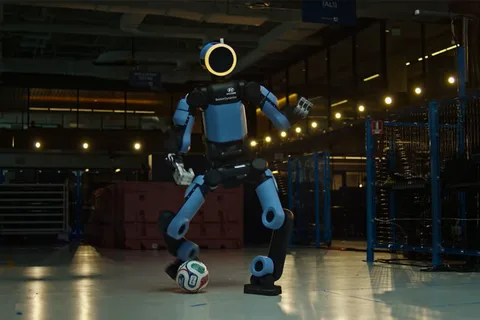
Ahead of the FIFA World Cup 2026, Hyundai Motor has unveiled “School of Football,” a new global campaign starring Boston Dynamics’ humanoid robot Atlas. Developed under the automaker’s “Next Starts Now” World Cup platform, the initiative uses football as a lens to showcase the next generation of human-centered robotics and artificial intelligence. Rather than focusing on technical specifications or conventional demonstrations, the campaign follows Atlas as it explores the sport and the emotions, creativity, and passion that surround it. Through a series of narrative-driven films, the robot learns from human players and fans, illustrating how advanced robotic systems can move beyond purely functional tasks. Hyundai says the project is designed to highlight the growing potential for robots to develop greater adaptability, responsiveness, and forms of expression inspired by human behavior. Atlas campaign reflects shift toward human-inspired robotics According to Sungwon Jee, Executive Vice President and Global Chief Marketing Officer at Hyundai Motor Company, the “School of Football” campaign uses the global appeal of football to present a more accessible and human-centered vision of robotics. It also frames Atlas’ journey as a way to explore how future robotic systems can be shaped by human qualities such as creativity, passion, and self-expression, rather than being defined solely by technical capability. As anticipation builds for the FIFA World Cup 2026, the campaign is positioned as a reflection of Hyundai’s broader belief that advances in robotics and AI can expand the boundaries of human-machine interaction. The narrative of the campaign opens with the robot studying the emotions, intensity, and energy of football fans, an experience that sparks its curiosity about the game. From there, Atlas moves into foundational training, learning core elements such as footwork, passing, and shooting. Each episode builds on the last, reflecting a step-by-step development process that mirrors human learning and adaptation. The series is designed to emphasize incremental growth rather than instant capability, framing robotics as a system that evolves through interaction and experience. Emphasizing real-world robotics and engineering precision At the center of the campaign is a demonstration of the next-generation electrically powered Atlas robot operating in real-world conditions. The film highlights “Physical AI” through embodied movement, with Atlas performing complex actions in dynamic, sport-inspired settings. Importantly, all sequences were executed without the use of computer-generated imagery (CGI), underscoring the authenticity of the performance and reinforcing the underlying engineering precision behind the platform. One notable example is the advanced “Ghost Rabona” a cross-leg kicking move that requires precise timing, balance, and deceptive motion, making it far more complex than simple movement replication. To execute it, Atlas studies detailed human football motion data and translates it into a physics-based simulation environment. The robot then trains through reinforcement learning, repeatedly refining its performance via trial and error to improve stability, accuracy, and execution quality. Performing the move depends on a combination of advanced capabilities, including dynamic balance control in unstable and asymmetrical positions, full-body coordination across multiple joints and limbs, real-time adaptation to shifting weight and momentum, and precise motor control under physically constrained conditions. Over the next period, Hyundai Motor will release additional behind-the-scenes content from its collaboration with Boston Dynamics , with the material set to explore the development and training behind Atlas’ movements, and offer technical insight into robotic learning and motion design.
Source: Interesting Engineering