



By Jeff Foust
Jun 16, 2026
Katalyst Space raises $12 million for GEO servicing demo mission
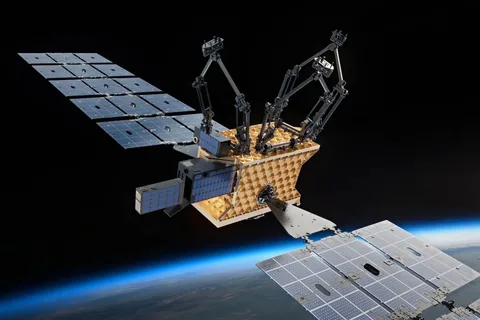
Katalyst Space Technologies plans to launch its first Nexus GEO satellite servicing mission in 2027. WASHINGTON — Satellite servicing startup Katalyst Space Technologies has raised $12 million for a geosynchronous orbit demonstration as its mission to boost the orbit of a NASA observatory nears launch. Katalyst announced June 16 that it closed a funding round led by Geodesic Capital with participation from Fortitude Ventures and other investors. The company said the funding will support development of its first Nexus spacecraft for servicing satellites in geostationary orbit. That mission is scheduled to launch in 2027 on an Ariane 6. Nexus-1 will initially approach a U.S. Space Force satellite and install a space domain awareness sensor on it, the company said earlier this year. It will also conduct additional rendezvous and proximity operations with national security spacecraft before providing services to commercial customers. “If we’re going to build an enduring presence beyond Earth, we need the ability to manipulate the environment. Katalyst is building the robotic spacecraft that will make that possible,” Ghonhee Lee, chief executive of Katalyst, said in a statement. Nexus-1 will come after the upcoming launch of its Link spacecraft, which is designed to approach NASA’s Neil Gehrels Swift Observatory, an astrophysics spacecraft whose low Earth orbit is decaying because of atmospheric drag. Link will attach itself to Swift and raise its orbit, preventing Swift from reentering as soon as late this year. The Link spacecraft is complete and was recently integrated with its launch vehicle, a Northrop Grumman Pegasus XL. That launch is scheduled for as soon as June 27, with the air-launched Pegasus flying out of Kwajalein Atoll in the Pacific. Katalyst’s rapid development of Link — NASA awarded the company a contract for the Swift reboost mission last September — among other work impressed investors. “Katalyst has shown an ability to move quickly while solving technically challenging problems,” said Tom Gillespie, head of Geodesic Capital’s Alliance Fund, in a statement. “They’ve consistently translated capital into technical progress while addressing a critical gap in space operations.” “The Katalyst team has consistently done more with less,” said Sungjoon Cho, founder of Fortitude Ventures, in the statement. “They’ve shown they can execute against ambitious technical milestones with remarkable capital efficiency and speed. More importantly, they’ve demonstrated that robotic servicing can make economic sense.”
Source: SpaceNews