



By @IntEngineering, Neetika Walter
May 28, 2026
NVIDIA validates sim-trained robots in real-world environments
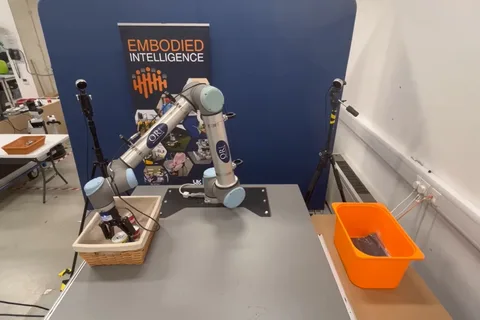
Robots trained entirely in simulation are beginning to perform more reliably in the real world, according to a series of new robotics research papers presented by NVIDIA at the International Conference on Robotics and Automation (ICRA). The studies focus on one of robotics’ biggest challenges: narrowing the “sim-to-real” gap, where machines trained in virtual environments struggle when deployed outside controlled lab conditions. NVIDIA Research said eight of its accepted ICRA papers demonstrated advances in robotic navigation, grasping, assembly, and reasoning using simulation-based learning systems. The projects aim to help robots adapt to unpredictable real-world environments instead of relying on rigid scripted behaviors. The work spans several areas of robotics, including multi-arm coordination, humanoid navigation, object manipulation, and vision-language-action models that allow robots to reason through tasks before acting. Robots leave the lab One of the highlighted systems, called COMPASS, trains robots entirely inside NVIDIA Isaac Lab simulations before transferring those skills to different physical robot bodies. Researchers said the framework achieved about 80 percent success across 20 real-world navigation trials involving autonomous mobile robots and humanoids, while improving average success rates by 4.5 times compared with imitation-learning baselines. Another project, Grasp-MPC, focused on robotic grasping in cluttered environments. Instead of relying on a fixed movement plan, the system continuously adjusts its motion while approaching objects. The researchers trained the model using two million simulated trajectories involving 8,000 objects. In real-world testing, the system achieved about 75 percent grasp success on unfamiliar objects, compared with 41 percent using baseline methods. NVIDIA researchers also developed a system called Deformable Cluster Manipulation designed for handling tangled or flexible materials such as tree branches around power lines. The framework trains robots to use their entire arm instead of just a gripper, allowing machines to gather or sweep aside clusters of objects in ways that resemble human movement. Smarter robots emerge Several papers also focused on improving robotic assembly and reasoning capabilities. The SPARR framework separates robotic assembly into two stages. A policy first learns assembly strategies inside simulation, while a second layer running on real hardware corrects errors caused by differences between simulation and physical environments. Researchers said the method improved assembly success rates by 38 percent and reduced cycle time by around 30 percent compared with zero-shot sim-to-real baselines. Another system called PEEK helps robots ignore irrelevant visual clutter while focusing only on objects needed to complete a task. NVIDIA said the framework improved real-world robotic accuracy by as much as 41 times for policies trained purely in simulation. A separate collaboration involving Carnegie Mellon University, the University of Utah, and the University of Sydney introduced SEAL, a framework designed to prevent robots from carrying out actions that differ from their planned reasoning steps. The method allows robots to evaluate multiple action sequences before choosing the one that best matches the original instruction. Beyond individual projects, NVIDIA said its broader robotics ecosystem continues expanding through open datasets and simulation platforms including Isaac Lab, Isaac GR00T X Embodiment Sim, and Omniverse NuRec.
Source: Interesting Engineering