



By @IntEngineering, Jijo Malayil
Jun 02, 2026
Pudu unveils new semi-humanoid robot capable of continuous learning
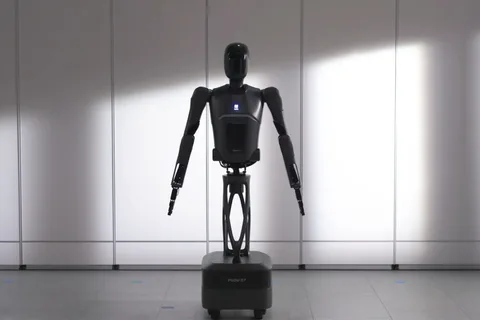
Chinese robotics firm Pudu has unveiled a next-generation industrial semi-humanoid robot designed for manufacturing and factory environments. The D7 robot combines industrial-grade hardware with embodied AI, powered by the company’s PuduFM 1.0 foundation model. Unlike conventional industrial robots that follow fixed programs and predefined workflows, the PUDU D7 can understand tasks, learn from experience, and adapt its actions in real-world settings. The Shenzhen-based company says the platform is designed to improve factory automation by enabling intelligent decision-making, continuous learning, and greater operational flexibility across a wide range of industrial applications. In 2024, Pudu unveiled Pudu D7, its first semi-humanoid robot, combining an omnidirectional chassis, robotic arms, and a human-like upper body. Adaptive warehouse worker D7 is a semi-humanoid robot designed to evolve through real-world experience rather than relying solely on pre-programmed capabilities. At the core of the system is an end-to-end data collection architecture that captures and processes operational data across a wide range of industrial workflows. Through low-latency transmission and synchronized data processing, the platform creates a continuous feedback loop that supports ongoing model training and performance optimization. Powered by the PuduFM 1.0 AI foundation model, the robot learns from real-world operations, gradually improving its understanding of industrial procedures, spatial relationships, and manufacturing processes. Unlike traditional robots whose capabilities remain fixed after deployment, D7 continuously enhances its performance through every task it performs. According to a statement by the firm, D7 is designed to improve efficiency in warehouses, factories, and logistics environments. Equipped with dual robotic arms, the robot can autonomously perform tasks such as material handling, shelf picking, inventory replenishment, and internal transportation. It supports payloads of up to 30 pounds (14 kilograms) and can operate at heights of up to 6.5 feet (2 meters), allowing it to interact effectively with high-rack storage systems. Its force-control technology enables careful handling of both heavy and delicate items, reducing the risk of damage during transport. The robot can also push carts and move materials across facilities. By integrating navigation, approach planning, grasping, and manipulation into a unified action framework, PUDU D7 eliminates the traditional separation between movement and operation, enabling more efficient execution of complex, multi-step tasks. Smarter industrial intelligence For applications requiring fine control, such as assembly, dispensing, and precision handling, D7 incorporates advanced tactile sensors that provide real-time force and pressure feedback. The system delivers millimeter-level force-control accuracy, automatically adjusting applied force according to task requirements and material characteristics. This enables stable, consistent operation while minimizing the risk of component damage. To operate safely in dynamic industrial settings, the robot is equipped with dual front-and-rear LiDAR systems and a comprehensive perception suite. These technologies allow it to continuously monitor its surroundings, detect obstacles, adapt to route changes, and navigate safely through busy factory environments with minimal infrastructure modifications. PUDU D7 supports fully autonomous battery swapping, allowing it to independently replace and recharge batteries without human intervention. This capability minimizes downtime and enables continuous 24/7 operation, improving equipment utilization and productivity. According to the firm, looking ahead, PuduAgent, its embodied AI agent platform, extends this vision by enabling robots to interpret user goals, break down complex workflows, coordinate navigation and manipulation tasks, and collaborate with multiple robots across different locations. Together, these technologies represent a shift from task-based automation toward autonomous systems capable of decision-making, long-term planning, and intelligent collaboration in industrial environments.
Source: Interesting Engineering