



By Jon Keegan
May 28, 2026
Report: Microsoft tries to get back in the AI coding game with new model
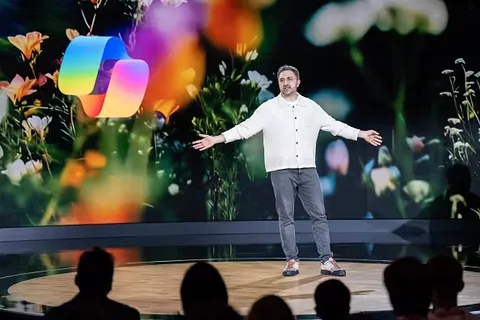
Microsoft wants to fight its way back into the AI coding field by releasing a new model next week at its annual Microsoft Build developer conference, The Information reports. The company is expected to announce a new family of models as Microsoft AI CEO Mustafa Suleyman seeks to shore up the company’s own AI offerings and gradually wean it off OpenAI’s technology over the remainder of their $13 billion partnership. Microsoft was initially well positioned to meet software developers with AI-enhanced tools. It owns GitHub, the most popular platform for hosting and sharing code, and GitHub’s Copilot AI-powered coding tool was released months before OpenAI’s ChatGPT debuted in 2022. But it fumbled one of the biggest first-mover advantages in history as Anthropic’s Claude Code, OpenAI’s Codex, and Cursor rolled out coding tools that developers loved. 42 Forty-two is the answer to life, the universe, and everything in Douglas Adams’ classic “The Hitchhiker’s Guide to the Galaxy.” It’s also the number of unsupervised Robotaxis Tesla has on the road in Texas, the only state where it’s operating autonomous service, according to records from a newly required government database in the state. That’s much lower than CEO Elon Musk had hoped, as the company struggles to ready its camera-only autonomous vehicles for commercial scale. In 2025, Musk said that the service would be available to “half the population of the US by the end of the year.” Even smaller competition has more: Avride has 317 and Nuro has 47. Meanwhile, Tesla’s chief rival, Alphabet subsidiary Waymo, has 577 in operation in the state. Nationwide, Waymo’s fleet currently numbers more than 3,000. Unfortunately for Tesla, figuring out how to actually scale its robotaxi fleet remains the ultimate question. An in-depth report from Reuters that interviewed nine former “data labelers” and a former Tesla self-driving engineer paints a picture of highly massaged safety stats, vehicles failing to execute basic driving functions, and a behind-the-scenes reality where the supposedly “autonomous” tech relies heavily on the exact kind of localized, labor-intensive mapping and training Musk has publicly mocked . The skepticism runs so deep that one former insider told reporters they wouldn’t ride in a Robotaxi “if you f---ing paid me.” Currently, the service is operating about 30 unsupervised vehicles across three Texas cities — a much more circumscribed execution than Musk had initially planned. The problem, for Tesla, is that the success of its Robotaxi business is now integral to the company’s value proposition . An in-depth report from Reuters that interviewed nine former “data labelers” and a former Tesla self-driving engineer paints a picture of highly massaged safety stats, vehicles failing to execute basic driving functions, and a behind-the-scenes reality where the supposedly “autonomous” tech relies heavily on the exact kind of localized, labor-intensive mapping and training Musk has publicly mocked . The skepticism runs so deep that one former insider told reporters they wouldn’t ride in a Robotaxi “if you f---ing paid me.” Currently, the service is operating about 30 unsupervised vehicles across three Texas cities — a much more circumscribed execution than Musk had initially planned. The problem, for Tesla, is that the success of its Robotaxi business is now integral to the company’s value proposition .
Source: Sherwood News