



By @IntEngineering, Jijo Malayil
Jun 15, 2026
Taiwan firm unveils next-gen humanoid robot for real-world operations
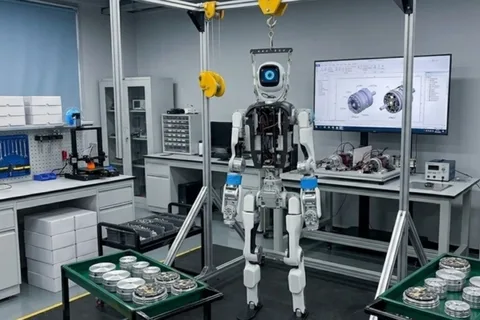
AI-powered brain enables reasoning and planning, while 3D vision, LiDAR, and sensors support balance and real-time interaction. A Tawniese firm has unveiled its first humanoid robot capable of interacting with the physical world. TM Technology, known primarily for integrated circuit design, has expanded its operations into sectors such as construction, green energy, and smart manufacturing, with support from its parent, Yinglin Group. TM Technology said the humanoid robot combines advanced hardware and software as part of a broader intelligent platform strategy, representing a significant step in its efforts to develop next-generation AI-powered robotic systems. Recently, Techman Robot from Taiwan unveiled its TM Xplore I humanoid at Nvidia GTC 2026 in San Jose, highlighting a collaboration with QCT and Nvidia. Embodied AI emerges As per reports, TM Technology’s newly unveiled humanoid robot combines AI, advanced manufacturing, biomimetic engineering, and multi-modal sensing technologies to operate in complex real-world environments. Designed as an embodied AI system, the robot features a layered architecture that mirrors key functions of the human nervous system. At its core is an AI-powered “brain” responsible for semantic understanding, reasoning, task planning, and decision-making. A dedicated “cerebellum” subsystem manages balance, posture control, locomotion, and coordinated movement, enabling the robot to perform tasks with greater stability and precision. The platform also incorporates a sophisticated perception suite that combines 3D vision systems, LiDAR sensors, and force-sensing technology to create a detailed understanding of its surroundings and support real-time interaction, reports Taiwan News (TN). The humanoid is equipped with multi-degree-of-freedom joints and dexterous robotic hands, enabling it to manipulate objects and perform a wide range of physical tasks. According to the company, the robot can handle transportation, inspection, assembly, and other precision operations that require coordinated motion and environmental awareness. Unlike traditional industrial robots that follow pre-programmed routines, the system is designed to adapt to changing conditions through learning-based interaction and intelligent decision-making. TM Technology said the development marks a shift from conventional hardware manufacturing toward integrated intelligent platforms. The company expects initial deployment in factories and logistics environments, where autonomous robots can assist with repetitive and labor-intensive tasks, before expanding into healthcare, caregiving, and household service applications as the technology matures, reports TN . Taiwan’s humanoid push Another Taiwanese firm, Techman Robot, recently unveiled its next-generation humanoid robot, TM Xplore I. The robot reflects Techman’s strategy of combining artificial intelligence with industrial automation under its “See · Think · Act – Powered by AI Robotics” framework. Unlike traditional bipedal humanoids, TM Xplore I features a humanoid upper body mounted on a wheeled mobile base, a design intended to improve stability, mobility, and operational reliability in factory environments. The platform combines autonomous navigation with dexterous manipulation, enabling it to transport materials, interact with workers, and perform precision tasks in industries such as semiconductor manufacturing, electronics assembly, and automotive production. The robot is powered by Nvidia’s Jetson Thor computing module, providing high-performance edge AI capabilities for real-time decision-making. It also incorporates Vision-Language-Action (VLA) technology, allowing it to process visual and language inputs simultaneously and translate them into physical actions. Techman’s software stack supports multimodal sensor fusion, generative AI inference, and autonomous operation. TM Xplore I further leverages Nvidia’s robotics ecosystem, including Isaac Sim for simulation-based training and testing, FoundationStereo for AI-powered depth perception, and Isaac GR00T for enhanced dexterity and autonomy. Together, these technologies enable faster deployment, improved adaptability, and more efficient automation in smart manufacturing environments.
Source: Interesting Engineering