



By Ariana Bindman
May 21, 2026
The SF gathering that summed up the ruthless class war billionaires are waging
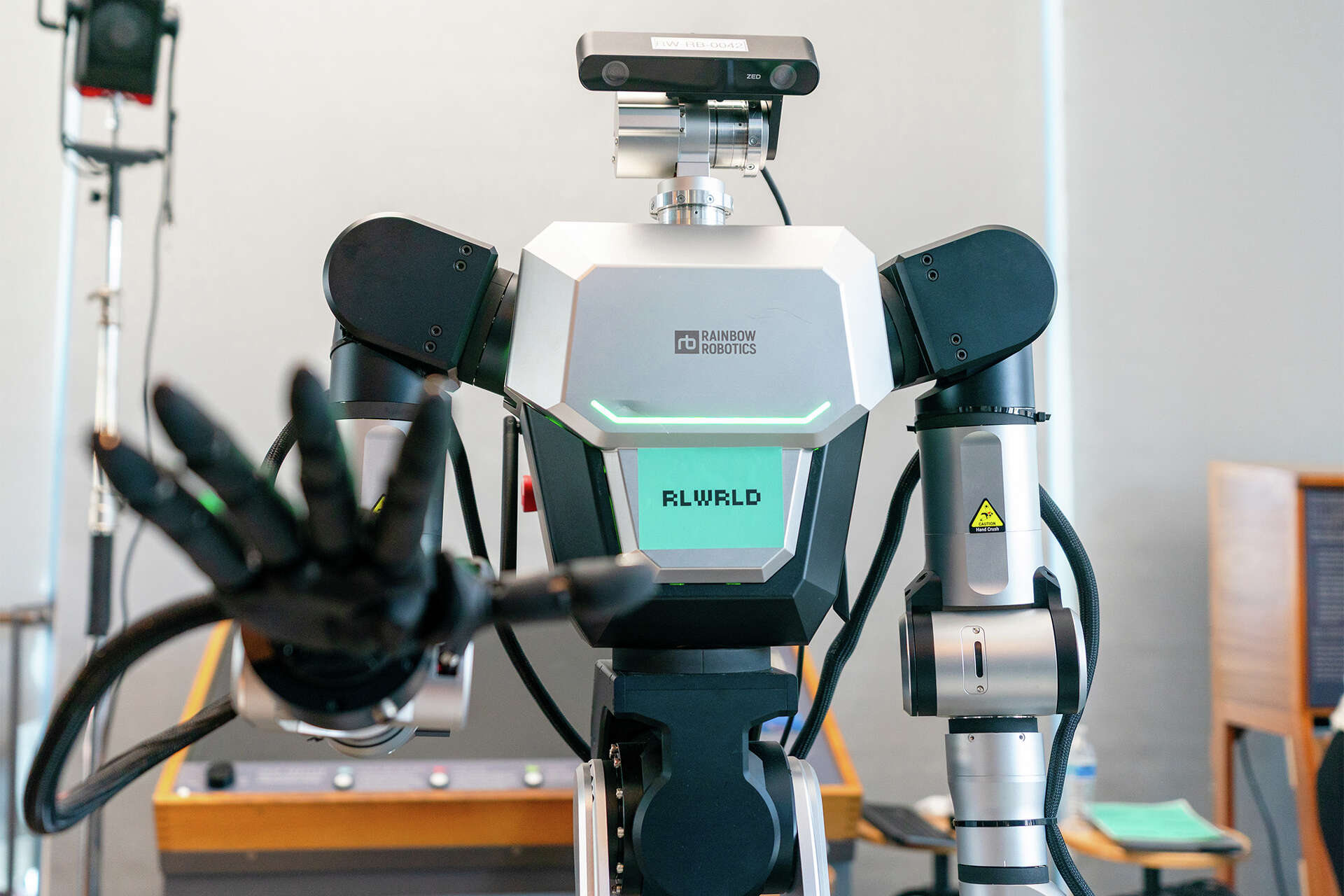
Recently, my partner told me about a 1973 short story by Ursula K. Le Guin called “ The Ones Who Walk Away from Omelas .” It’s about a utopian city where hedonistic residents live in peace, abundance and harmony among its rollicking meadows and hillsides. But these same euphoric citizens harbor a shameful secret that they refuse to acknowledge: In order to maintain their bountiful harvest, their family’s health, and the beauty of their town, they must torture a bruised, helpless child trapped inside in a room. Once exposed to this known secret, some people decide to leave Omelas — but many don’t. For the past several months, I haven’t been able to figure out why San Francisco has been making me feel so depressed, I told him. Maybe I was outgrowing urban life, I thought, or maybe the skyline, riddled with nonsense tech billboards , just seemed grayer than usual. But after attending an exclusive robotics demo in the city last Wednesday, I finally realized why. RLWRLD participants test a humanoid robot before displaying its capabilities for a demo at the Dexterity Night hosted by RLWRLD in San Francisco on Wednesday, May 13, 2026. Adam Pardee/For SFGATE RLWRLD CEO Junghee Ryu speaks about the robotics company and the progress they have made with their robot at the Dexterity Night hosted by RLWRLD in San Francisco on Wednesday, May 13, 2026. Adam Pardee/For SFGATE Hosted by an artificial intelligence robotics company called RLWRLD, the highly anticipated expo, called Dexterity Night in SF, unveiled the RLDX-1, a robotic model that enables humanoid machines to perform “contact-rich” tasks like pouring coffee and using tools on assembly lines. As we all know by now, AI is slowly infiltrating white-collar jobs, and hand dexterity is the final frontier that major tech companies aim to conquer. Though RLWRLD’s team assured me that these robots are not meant to immediately replace people, I find this impossible to believe — after all, they pointed to a 2017 McKinsey analysis “which found that currently demonstrated technologies could automate activities equivalent to approximately $15.8 trillion in global wages,” especially in manufacturing and retail sectors. American manufacturing employs more than 12.5 million workers, according to the U.S. Bureau of Labor Statistics , and high-powered executives participating in the RLWRLD event said that dexterous bots could be mass produced as soon as the next 12 to 18 months, potentially putting many of those roles at risk. “If robots are going to do real work in factories, kitchens and warehouses, they need to grasp, feel and hold on,” RLWRLD CEO Junghee Ryu said in a company news release shared with SFGATE. “RLDX-1 was built from day one to fill that gap.” A humanoid robot drops a pair of socks in a bucket during a demo at the Dexterity Night hosted by RLWRLD in San Francisco on Wednesday, May 13, 2026. Adam Pardee/For SFGATE Authors of the 2017 analysis that made bold claims about capturing trillions of dollars of wages estimated that automation in grocery stores, for instance, could have a “significant impact on staffing needs,” slashing work hours by 65% among cashiers, shelf stockers and cleaners — workers who have repetitive, predictable tasks that robots can be trained to mimic. “Many jobs in retail are entry-level, low-skill ones, and the elimination of many such positions could cause a public outcry,” the authors casually note, suggesting that policymakers provide social safety nets for newly unemployed workers, such as universal basic income. But does an army of bots really pose a threat to the millions of alleged “low-skill” jobs that many of us rely on? A humanoid robot on display during a demo at the Dexterity Night hosted by RLWRLD in San Francisco on Wednesday, May 13, 2026. Adam Pardee/For SFGATE A humanoid robot on display during a demo at the Dexterity Night hosted by RLWRLD in San Francisco on Wednesday, May 13, 2026. Adam Pardee/For SFGATE When I arrive at the Exploratorium for the unveiling of the RLDX-1, I’m immediately confronted by a group of servers nervously grinning and holding algae-blue cocktails by the stairwell. Meanwhile, to my right is a disembodied robot hand sticking out of a table, evoking the 1959 German horror film “The Head.” Blaring over the sound system are Justice’s overpowering techno track “Genesis,” which samples an infamous scene from “Mothra vs. Godzilla,” and Daft Punk’s “Technologic,” which features a disturbing flesh-robot hybrid. It’s fitting, given the monstrous nature of the event. Overall, it feels more like a club with subliminal sci-fi themes than a product demo geared toward Ivy League nerds. As I stood near an empty table that was slowly accumulating trash, stylish attendees with understated leather jackets and baggy pants mingled over hors d’oeuvres and nonalcoholic drinks. I couldn’t tell what was scarier: the disembodied robot limbs, or the fact that this new generation of young tech workers actually looked cool. After running behind schedule, the presentations finally begin. “You guys are the very lucky ones,” an executive says to us as prerecorded robot demonstrations play behind him. The crowd cheers, despite the grim implications. In the corner, I watch one humanoid bot slowly catch, and then miss or drop, several pairs of socks rolling down a conveyor belt. The first thing I notice is that it’s painfully slow to react: Each time it manages to grab them and dump them in a receptacle, it takes several seconds — it’s like watching my stoned college roommate try to cook a steak. RLWRLD CEO Junghee Ryu speaks about the robotics company and the progress they have made with their robot at the Dexterity Night hosted by RLWRLD in San Francisco on Wednesday, May 13, 2026. Adam Pardee/For SFGATE A RLWRLD participant discusses their robot with guests at the Dexterity Night hosted by RLWRLD in San Francisco on Wednesday, May 13, 2026. Adam Pardee/For SFGATE As the night dragged on, one CEO after another took the stage. They said something about benchmarks. Something about functionality. Something about memory. Something about capturing movement. People cheered. At one point, a man next to me actually slow-clapped. I was supposed to be paying attention to a seemingly important panel with Nvidia executives, but I couldn’t stop thinking about the absurdly small 1-inch tacos they were serving at the event instead. How did they make the tortillas so tiny? Why are they vegan? As Steve Buscemi pondered in the cinematic masterpiece “ Spy Kids 2 ,” does God stay “in heaven because he, too, lives in fear of what he’s created here on Earth?” Stay informed, and entertained. By signing up, you agree to our Terms Of Use and acknowledge that your information will be used as described in our Privacy Policy . What really struck me the most, though, was the casualness of these presenters, and the polite euphemisms they used to describe human displacement. Tech leaders — and their financial backers — are gleefully trying to usher in “ potentially epochal social, economic, and employment repercussions ” through these robots, and the bottom line is that they just don’t care about the aftermath. They don’t care that data centers are depleting precious natural resources and creating heat islands. They don’t care that fake job postings are demoralizing unemployed workers. And they certainly don’t care about the thousands of recently laid-off employees who can’t feed their families. Why would they care about robbing retail workers of their livelihoods, especially when they’re the ones profiting off of it? A humanoid robot picks up a pair of socks during a demo at the Dexterity Night hosted by RLWRLD in San Francisco on Wednesday, May 13, 2026. Adam Pardee/For SFGATE A robotic hand senses a guest’s hand and grabs it during a demo at the Dexterity Night hosted by RLWRLD in San Francisco on Wednesday, May 13, 2026. Adam Pardee/For SFGATE By the end of the night, my ears were ringing, the taste of tiny, bland, vegan tacos still lingering in my mouth. Despite merely standing around, somehow, I felt completely drained. What gives me hope as I write this, though, is seeing the people rebel. We need college grads to keep booing the corporate shills who selfishly try to use their graduation ceremonies as AI advertising platforms; we need more communities to push back against the construction of data centers in their towns. Companies want to wrest control of our futures, and we just can’t let them. Maybe I’m naive, or an idealist, but I’m optimistic that if we continue to use our voices, we can win this ruthless class war that billionaires are waging on us.
Source: SFGATE