

By Dikshant Sharma
Jun 07, 2026
Top 10 AI Engineering Books for 2026 That Will 10X Your Skills in LLMs & AI Agents
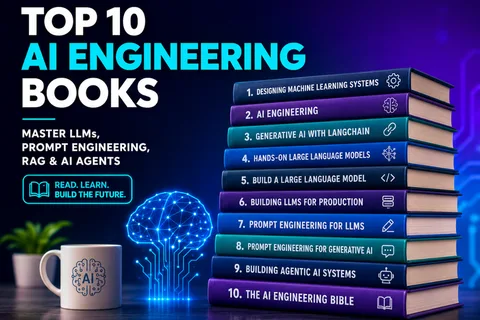
AI Engineering Books: Artificial Intelligence is evolving at lightning speed, with new models, frameworks, and tools emerging almost every week. While tutorials and videos help beginners get started, books offer a deeper, structured understanding of AI engineering. For anyone working with Large Language Models (LLMs), prompt engineering, retrieval-augmented generation (RAG), AI agents, or full-scale AI product development, the right books can significantly sharpen practical skills and industry readiness. Top 10 AI Engineering Books for 2026 This curated list of 10 must-read AI engineering books for 2026 covers everything from fundamentals to advanced production-level systems. Take a look: You Might Be Interested In 1. Designing Machine Learning Systems Written by Chip Huyen, this book focuses on real-world machine learning engineering challenges. It explains how to build, deploy, and monitor ML systems that actually work in production, including data pipelines and system design. 2. AI Engineering This book shows how to turn AI models into real products and services. It covers system architecture, deployment strategies, model selection, and building reliable AI applications for production environments. 3. Generative AI with LangChain A practical guide to building LLM-powered applications using LangChain. It explains how to create chatbots, Q&A systems, and RAG-based applications by connecting models with APIs, databases, and external tools. 4. Hands-On Large Language Models This book blends theory with practice, covering transformers, embeddings, semantic search, and model fine-tuning. It is ideal for developers who want to build and experiment with LLM-based systems. 5. Build a Large Language Model A deep technical guide that explains how to build a GPT-style model using Python and PyTorch. It covers tokenization, attention mechanisms, pre-training, and fine-tuning to help readers understand LLMs from the ground up. 6. Building LLMs for Production Focused on real-world deployment, this book covers scaling, evaluation, monitoring, prompt engineering, and RAG systems. It highlights how to move from prototype AI apps to production-ready solutions. 7. Prompt Engineering for LLMs This book explains how prompts influence AI model behaviour. It covers prompt patterns, few-shot learning, reasoning techniques, and structured prompting methods to improve model outputs. 8. Prompt Engineering for Generative AI A broader guide to prompting across text, code, images, and multimodal systems. It focuses on creating consistent and reusable prompts for real-world applications. 9. Building Agentic AI Systems This book explores AI agents that can plan, use tools, and perform multi-step reasoning. It explains how modern agent frameworks work and how to build autonomous AI systems. 10. The AI Engineering Bible A comprehensive reference covering AI engineering fundamentals, LLMs, system design, infrastructure, and deployment. It serves as a guide for both beginners and advanced practitioners. Disclaimer: This article is based on recommendations. Readers are encouraged to explore books based on personal preferences.
Source: The Sunday Guardian