



By Vineer Bhansali
Jun 18, 2026
Why SpaceX Is A Call Option On Elon Musk And What It Tells Us About The Tails
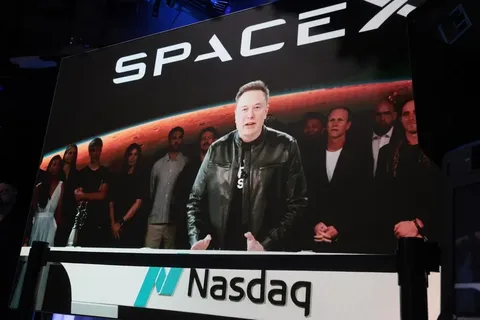
NEW YORK, NEW YORK - JUNE 12: Elon Musk, founder and CEO of SpaceX, speaks via video before the ringing of opening bell at the Nasdaq Marketsite at the launch of the company's initial public offering (IPO) on June 12, 2026 in New York City. SpaceX is set to begin trading under the ticker SPCX following what is expected to be the largest initial public offering in history. Elon Musk, who also serves as chief executive of Tesla, could become the world's first trillionaire. In a filing with the Securities and Exchange Commission, the company said it plans to raise $75 billion by selling 555.6 million shares at $135 each. Like all market participants, I have been following the SpaceX IPO and its aftermath closely. As a follower of “tails”, on both the left and right side, this IPO provides a great laboratory to test out some ideas and hypotheses on how the markets are pricing risk and reward in the extreme parts of the distribution. It also reveals new facts about how “hopes and dreams” can bring out the massive amounts of liquidity that has been sitting in cash and money market funds. As I write this, the firm is valued at about $2.7 trillion, with only a small amount (less than 5%) in “float”; i.e. stock that can be traded. But by any measure, this IPO and its aftermath, so far, has been a raging success. We can value any stock’s price as the sum of a visible “base” business and a bunch of options, all of which need to be priced based on some speculation for the company’s growth profile. If you have perused through the prospectus, as I have, the first thing to notice is that the firm is a conglomeration of many different lines: Starlink, which is profitable, and others, such as the AI business, which, for the time being, is quite unprofitable. So the core, namesake business is impressive, but nothing that can justify the valuation. Most of the value has to arise from the “optionality” embedded in the credible vision that convinced Musk fans. The dream is that SpaceX can pull off an amazing feat: using its Starship launch vehicle, which has not yet gone into orbit but will launch not only more communication satellites, but also satellites that will essentially orbit the sun and act like massive data-centers...and then onwards to Musk’s long-held dream of colonizing Mars and beyond. Using the option framework, we can price up SPCX as a “right-tail” option which is the sum of a “platform” option and a “moonshot” option. Indeed, the moonshot is what excites retail and many professional investors – everyone wants to own an option that can, well, go to the moon, or beyond. Retail investors especially are flush with massive amounts of liquidity they accumulated after the COVID-19 money-printing episode, and much of this liquidity was parked in money market funds, hence easily accessible. Retail traders have also discovered options, which allow them to massively lever their views up. Combine the liquidity they have with the possibility of a multiple return on their investment, and you have the ingredients where this option appears to be a must-own, which is why a good slice of the allocation was reserved for retail. For SPCX, the platform option consists of all the scalable technologies such as Starlink, direct-to-cell, and defense applications, which will get scaled once Starship is operational, and the moonshot option consists of Mars occupation and orbital AI “compute”. To build all of this out, more equity will need to be sold to raise cash, resulting in dilution of existing holders, so we have to adjust for this dilution. Actual options started to trade on the stock yesterday, implied volatilities are in the 100% range for very short-dated options, and close to 80% for options expiring in January 2028 (Source: Bloomberg). Not surprisingly, this high implied option volatility is what one would expect for an option on an option – which is what is called a “compound” option. The “outer” option is the one that expires first, and the holder of that option chooses, if the second, “inner” option is valuable, to exercise the first option and hold the second, inner option to its expiry. We will use this information below. The first option (the “outer option”) is whether by the end of 2027, or early 2028, Starship has had success in launching to its cadence that will be necessary. We can think of this first option as one with a binary outcome – either Starship is on a frequent flight cadence to set up for Mars and orbital AI, or it isn’t. If it is not successful, and rockets repeatedly blow up on launch, then of course all bets are off and the second (moonshot) option is worthless. On the other hand, the person in charge here is Elon Musk, who has frequently defied skeptics and delivered the close to impossible. If Starship gets on its flight cadence, then this first option goes into the money, and the second option (the “inner option”) of Mars/orbital AI becomes a possibility. Let us give Musk 10 years to have this second option pay off for this discussion. Now we have all the ingredients to build a simple compound option model. The first option is a success/failure binary coin flip with some probability, and the second option is a regular option with a 10-year horizon with its own volatility and strike. The strike for the second option is the amount of capital expenditure required (I used $750 billion, a made-up number based on what I think will be needed to make all the orbital AI satellites etc. a reality), and I used a volatility of 75%. Given the market price of the stock, now priced as a compound option, I can extract the implied probability of the first option; i.e. Starship flying on its cadence or not. I find, through iteration, that the market is implying a probability of 60% to 70% for the current price to be fair at the current $2.7 trillion valuation. In other words, with Musk at the helm, the market is confident that even though Starship has not yet orbited, it will do so in the next two years with better than 50/50 odds. If you are skeptical of these odds, then the price of the stock is too high. If you are a believer, then the price is probably fair, and maybe even cheap. But at-least this gives us something to calibrate our beliefs against in relatively short-order, and re-calibrate if the facts change. So there we have it. SPCX is a bet on Elon Musk succeeding in his audacious goal. Since no one has a precedent for this exact experience, the stock price is really an option bet on the tails being realized. And those tails, on both sides, are levered bets on Musk succeeding or failing. No wonder then that despite complete control over every decision, the IPO was such a success – the market sees that the bet on SpaceX only succeeds if Musk gets to make the decision. In other words, the success of the IPO was exactly due to Musk’s oversized voting power on the stock, not despite it. If this company had followed a more traditional governance process, the IPO would likely have done much worse. The good news for investors (and indirect investors who will have SpaceX shares end up in their 401ks) is that in the next years they will know how much this faith in Musk was justified, and how much was just hopes and dreams. From a timing perspective, the IPO clearly timed the discovery of owning optionality by the retail and a good chunk of the professional investor crowd. But there is a bigger message here. The market is still, collectively, willing to bet on moonshots, and those are the kind of bets that bring liquidity out of T-Bills and money market funds. In other words, betting on the tails on a massive scale is now definitely moving into the mainstream.
Source: Forbes