



By News Desk
Jun 15, 2026
You won't get 'AI'd' in these tech-savvy trade jobs
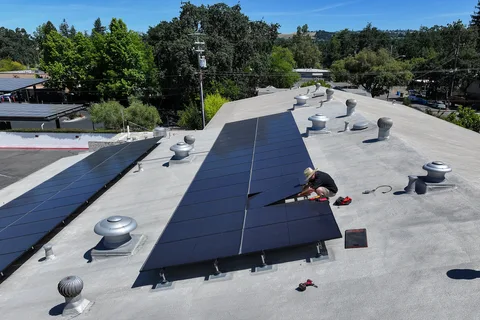
If the worry these days is that AI will take over just about every job, many workers in the occupational trades seem less concerned. But understanding and working with technology is a must. It starts in apprentice programs and continues to the job site. “In apprentice and training programs, technology supports classroom and hands-on training through tablets, digital curriculum, online training and safety modules, videos and testing,” said Rick Wells, CEO of Marin Builders Association. “In the field, it helps with plans, photos, time tracking, safety documentation, inspections, change orders, layout, drones and communication between crews, supervisors and the office.” The organization has 565 members throughout the North Bay who represent most every kind of contractor as well as people who do business with contractors. Technology is part of most trades, including electrical, HVAC, plumbing, solar, roofing, painting, civil, grading and general contractors. Rick Wells (Chris Applebaum photo) “They use it for digital plans, estimating, diagnostics, layout, drones, GPS, project management, scheduling, safety, controls, documentation, color matching, coatings specifications, site photos, inspections and project communication,” Wells said. “Technology — including tools like drones, AI, and field software — should help strengthen the trades, not diminish them.” Wells believes as technology continues to progress, the core fundamentals of a good employee and quality work will remain at the forefront. “What should not change is the value of skilled labor, craftsmanship, safety, mentorship and pride in the work,” he told the Business Journal. Technology was first introduced in front offices. Accounting, estimating and communication were some of the primary ways tech first seeped into trades. Mike Ghilotti (Courtesy: Ghilotti Bros.) Mike Ghilotti, president and CEO of Ghilotti Bros. Inc. in San Rafael, remembers when it was a big deal to get a fax machine. Now, his team uses iPads along with specific software and apps for the construction business. They use technology to plan and schedule work, as well as determine if they are under or over budget. Learning to use tech Wells doesn’t believe the need to understand and be comfortable around technology is going to keep many people out of construction, especially younger applicants. “It may be a barrier for a few, but in today’s tech world of handhelds, it is less and less common. The foundation is still reliability, work ethic, safety, problem-solving and willingness to learn. Technology is another tool, and we should make it approachable,” he said. Frank Cuneo used to be a sheet metal worker. Now, he is director of North Bay Building Trades Council’s Trades Introduction Program (TIP) in Santa Rosa. It serves Marin, Sonoma, Lake and Mendocino counties. Students in the pre-apprenticeship program offered by North Bay Building Trades Council. (Photo by Frank Cuneo) For nearly a dozen years TIP has offered what it calls a pre-apprenticeship program three or four times a year. The course is 128 hours. This compares to an actual apprenticeship via a union that is yearslong. “The average age is about 30 years old. Most of them are out of high school for a little while and are looking for something better in terms of employment,” Cuneo said. A recent grad went from being a dental technician to a painter apprentice. Understanding and using technology is definitely part of TIP’s curriculum. Cuneo remembers when cellphones used to be banned on job sites. Now, they are another tool — could be used to calculate something or look up references. Laptops and tablets are used to access plans, details about installation standards, and even building codes. “Technology is allowing more people with different abilities to be in the trades. You used to have to lift 100 pounds, and be tough and bulky,” Cuneo said. “Now, more jobs rely on fine motor skills and using the tools you have. It’s opened up the field to others.” There’s an app for that Connected Apprentice, while not used in the North Bay, is utilized by 12 of the country’s largest construction trades — including nearby in Sacramento, Milpitas, Berkeley, San Jose, Concord, Hayward and San Francisco. Steve Meltzman (Courtesy: iBusiness Technologies) “It is a technology bundle that helps trades modernize apprenticeship training,” explained Steve Meltzman, CEO of iBusiness Technologies, which developed Connected Apprentice. He said unions have forever handed out three-ring binders full of information. Now, they distribute iPads, as Apple is a partner with Connected Apprentice. In addition to learning on a tool that will be ubiquitous in the field, any curriculum updates are essentially automatic without printing reams of paper. Even though the information is the same, Meltzman said Connected Apprentice may provide “deeper learning because with iPads instructional material can include video and rich diagrams.” Community college path While many people go through trade unions for training via apprentice programs, local community colleges are also a path to knowledge and employment. Santa Rosa Junior College’s courses are diverse, ranging from industrial trades that include welding, advanced transportation and logistics; to advanced manufacturing, which was formally machine shop; to building trades, which cover HVAC and carpentry; and culinary arts. Plus, the Petaluma campus has a free, non-credit carpentry program that’s all about learning vocational skills. About 75% of students enrolling in these trade programs obtain certificates, with the other 25% earning an associate’s degree. “We feel like if we can train students with modern technology in the trades, they will be better positioned in the workforce and command higher starting wages,” Benjamin Goldstein, dean of Culinary Arts, Industrial & Trade Technologies, Construction Training Center, told the Business Journal. With multiple computer systems being part of every automobile, as well as cameras and sensors, technological know-how is a must to be a mechanic. No longer is being handy with a wrench going to be enough. Heating, ventilation and air conditioning (HVAC) systems are far from simple. SRJC students work on the same simulation software the professionals use. “If a system stops working, there could be a thousand reasons why. So, you need to understand various different faults in the equipment,” Goldstein said. While students in culinary arts are still using pots and pan, gas and induction, and various food stuffs, the biggest change with technology is in the front of the house — as in with point-of-sale software and devices. It’s learning programs for taking reservations that don’t involve answering a phone, and how card readers work. “There’s a whole art and science to syncing orders,” Goldstein said. Rather than offering traditional trade certification programs, Sonoma State University works “closely with North Bay employers and community partners to help students develop the critical thinking, communication and creative problem-solving skills that translate into key roles within sectors such as business, healthcare, education, hospitality, wine and agriculture, and public service,” a spokesperson said. “Experiential learning opportunities, internships and community-engaged projects are deeply embedded throughout our curriculum, ensuring our students apply theoretical knowledge to real-world challenges,” Sarah Ellison, Sonoma State’s associate vice president for student affairs, said in a statement. Napa Valley College declined to participate in this story. Real-world applications When John Matheny started in the solar and electrical field in 2009, to get a system up and running was 99% physical work, 1% technology based. “When you were done wiring up a solar inverter, you turned the switches on, and it started producing. We would occasionally install monitoring systems, but this was done by one person who specialized in it, and it had no effect on how the system performed, only how its performance was viewed,” said Matheny, who owns Matheny Electric in Sebastopol. Electrician John Matheny, owner of Matheny Electric, uses his smartphone to fine tune an electrical inverter after repairing a solar panel repair at the Odd Fellows Hall in Santa Rosa on Wednesday, June 10, 2026. (Christopher Chung/The Press Democrat) “Now, depending on which manufacturer of products is being installed, a much larger portion of the work involved to get a system up and running properly is done through a smartphone or from a desktop browser remotely,” he said. Matheny didn’t take the typical route via an apprentice program to become a certified electrician and electrical contractor. He studied on his own time and took online classes. Going forward, there are likely to be less people like him or those who mostly learn on the job. “High technology acumen is very important. I can train on the job for many things that we do; bending conduit, sizing wire, making connections, etc.,” Matheny said. “Keeping track of app log-ins, emailing, uploading photos and that kind of thing are much harder to train if someone does not have a strong technology background.” Solano Glass Co. in Fairfield uses tech in the office, not in the field. It used to be deals were made over a handshake; estimates weren’t signed because there was an innate sense of trust. Genie Branson, co-owner of the company, said now everything is put in ink. Bills are paid online; checks are practically obsolete. When it comes to marketing her business, it’s social media via technology that trumps newspapers. Ghilotti works with a slew of trades people in the construction business like cement workers, masons and carpenters. His workforce is made up of five unions. “The pros of technology is that you can do things much quicker with greater accuracy and efficiency. It’s enabling field crews to have information,” Ghilotti said. “The cons are that sometimes we get too reliant on technology and don’t use common sense to think through issues and problems.” Technology is also a tool in bringing job seekers and employers together. Chris Simmons is founder and CEO of HammerLoop, an online construction hiring platform based in Tiburon. The app is modeled off dating apps. Instead of having people search for love, they are either looking for workers or seeking a job. With the initial focus being on recruiting applicants, HammerLoop has 1,350 want-to-be workers signed up and 150 employers. This is as of early June, with the app only available since the first of the year. The test geographical triangle went from Marin County to Sonoma County to Sacramento County. Idaho and Texas are the next markets. Simmons said with 50% of the construction industry Spanish-speaking, the app is available in Spanish and English. It costs nothing to list a job or one’s profile, or to peruse the site. However, if you want to swipe right, so to speak, then job seekers must pay $7 per month for unlimited use and employers pay $100 per month for unlimited access. Chris Simmons (Courtesy photo) “Eventually they will see more jobs and have a better sense of their local market, and be better informed of pay scales,” Simmons said of workers. “Even if their profile is not in active mode, they will get notifications coming across.” This gives them insight into who is hiring, where and potential earnings. Simmons said until now the best way to find a construction job was word of mouth. HammerLoop, he believes, will dramatically alter how people find their next job. He expects to have 20,000 profiles on the site within the first year. Looking to the future Solano Glass Co. isn’t worried AI will replace glass installers. It takes people to do that job, and they don’t see that changing. Wells, with Marin Builders, said, “There will absolutely continue to be a need for skilled labor for the foreseeable future. Technology and AI will change how work gets done, but they won’t replace judgment, adaptability, hands-on skill and real-time problem-solving on a jobsite.” In fact, everyone interviewed for this story believes people will always be needed in the trades. “Technology is a fundamental tool used by supervisors to succeed in today’s world of construction, but if you just want to come out, work hard, be a part of a great team and build incredible things, there are still great opportunities in the construction trades,” Ghilotti told the Journal. “More importantly, there’s a good likelihood that AI will not replace those workers for a long, long time.” One way AI will help those in the trades is that those workers will be the ones building the data centers. “That construction boom is real. There is a huge demand for masonry, concrete, electricians, plumbers and HVAC techs,” Goldstein said. While those centers might not be in the North Bay, he knows what SRJC students are learning will provide them the opportunity to be strong candidates for those jobs. For Jack Buckhorn, executive director of North Bay Labor Council, AFL-CIO based Santa Rosa, he knows working in the trades makes for a good life. He was an electrician before taking a leadership position in the union. (The council represents more than 70,000 workers and about 70 union affiliates in Sonoma, Lake, Mendocino and Marin counties.) “It’s a great middle class career that isn’t going to be outsourced or AI’d,” Buckhorn said. “We are going to continue to build things. That is not going to go away. It’s great for people who want to work with their hands.”
Source: The Press Democrat