



By Alex Kirshner
Jun 05, 2026
A Wall Street Institution Just Did Something to Elon Musk That No One Else Will
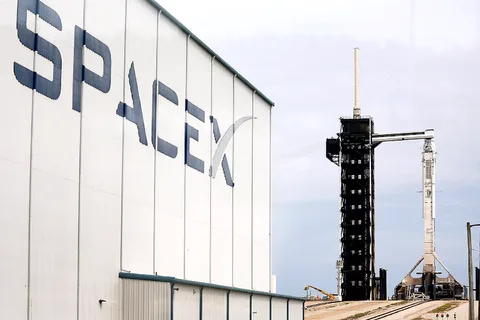
Finally, a group of institutionalists has managed to humble Elon Musk in a way that will actually trouble him. The rebel leaders are, uh, the people in charge of the S&P 500. If this sounds like wishful thinking, you can hardly be blamed. Musk is on an all-time run of occasionally looking as if he’d be laid (relatively) low by some party or other, only to come out smelling like a rose. Get forced to buy a social media platform he doesn’t want? Well, it’ll turn out to pay for itself many times over by rendering Musk a kingmaker among conservatives. Illegally destroy large chunks of the federal government, leading to a toxified reputation and an investor perception that he’s distracted, thus dragging down Tesla’s stock? Well, it recovered those losses and then some. Have a public falling-out with Donald Trump after all that? No big deal, apparently, as Musk continues to enjoy government contracts and use his slopified platform to tilt our discourse to the right. There has been no beating this guy. But what S&P Global decided on Thursday will at the least annoy the hell out of Musk for a while. The corporation behind the famous stock market indexes announced that it wouldn’t fast-track SpaceX for inclusion into the S&P 500. It will deny billions of dollars in stock purchases of the company, Musk’s latest to go public. And it will preserve credibility for the most important index on the market, while keeping unwitting buyers from subsidizing a business that has not earned the right to their largesse. Musk is going to hate this, and for a rare change, there’s nothing he can do about it except hope that the people across from him change their mind. Inclusion in these indexes or the stock exchanges they’re tied to means many billions of dollars pouring into those stocks. Think of it this way: If you’re reading this, you might never buy stock in a Musk company on its own. But if he’s in the S&P 500, you’re purchasing a little chunk of Tesla, which makes up about 2 percent of S&P index funds, every time you put money into such a fund. That’s many millions of people pushing the price of his stocks even higher, with their fund provider taking their money and using it to lift Musk’s holdings. Now, this shouldn’t be possible with SpaceX. Exchanges and indexes have rules that companies must meet to be included. One of them is that to get into the S&P 500, a company has to have been profitable in its most recent quarter, as well as over the past year in the aggregate. It doesn’t need to stay profitable forever to be in the index, but it can’t enter from a place of bleeding cash. SpaceX lost $5 billion last year even as its revenue went up by a third. That made this an open-and-shut case, except nothing’s ever that way with Musk. Other index businesses have already announced they’ll change their rules to include SpaceX (along with soon-to-be-public A.I. companies Anthropic and OpenAI). Yet here was S&P Global, announcing this week that it would not follow other financial institutions in changing its rules to feature SpaceX in its stock market indexes. This will prevent millions of people from purchasing SpaceX stock via their index-fund contributions, denying Musk a huge pipeline of buyers to push up the price. Had SpaceX gotten into the S&P 500, a percentage of the several trillion bucks in S&P 500 index funds would’ve gone toward SpaceX stock. Over a few years, that could easily mean more than 100 billion of all of our dollars being used to obtain the stock, even with SpaceX offering only a tiny segment of its shares to the public. Not getting access to the funds doesn’t mean that SpaceX won’t still raise its desired funds via its initial public offering: It makes about 5 percent of its stock available at a certain price, institutions and a few regular people buy it, and the company takes the money. But without S&P 500 index-fund demand, the stock price doesn’t go up a teensy bit every time people in those funds make a retirement contribution. Meanwhile, you, the investor, don’t have to worry about your money going to an enterprise that has not demonstrated the reliability that S&P 500 companies are supposed to. (You’re also not supporting Musk’s wealth any more than you already are via Tesla’s inclusion.) This won’t relegate Musk to the poorhouse. It won’t even downgrade him to not being the richest guy who has ever lived. But it will prevent a lot of people from unknowingly getting stuck on a rocket (SpaceX term) that has not passed the index’s usual safety inspection. Musk is clearly not subject to the federal laws of the United States, and his companies have never been subject to the norms of the market. But here, we’ve got exactly one area in which Musk has turned out to not be special. I’m as shocked as you are. How this will affect returns for index-fund investors is uncertain; it depends on SpaceX’s performance relative to the S&P. But for those of us who are devoted to the idea of index-fund investing and want it to continue to work well for decades to come, this is good and critical news. Index funds do not promise a specific return, other than that holders will do exactly as well as the index, minus an infinitesimal annual fee. The index, of course, has done well for many decades. The S&P’s overlords cannot guarantee that this will continue, but they can treat as sacred the rules that give the index credibility. This does not mean that companies doing seedy, speculative things won’t be included in the S&P 500. You need only look at the index’s crypto treasury companies, now affecting all of our retirements, to realize that that isn’t the case. But those companies had to follow a procedure to get into the mix and benefit from our money. That requirement has weeded out a lot of bad candidates for our investments. After all, the reason this is such a blow to Musk is that the S&P 500’s rules are working well. Thanks to the visionary brilliance of Vanguard founder Jack Bogle and decades of strong returns, indexing is eating more and more of the market each year. This very week, Vanguard’s S&P 500 fund (VOO) became the first exchange-traded fund (joining several index funds) to clear $1 trillion in assets. A couple of competitors are not that far behind. People like index funds in general, but they have a particular taste for S&P 500 funds, which are hundreds of billions of dollars ahead of any other funds. Most people are not reading the fine print and are just enjoying the returns, but the S&P people deserve real praise for understanding the importance of their brand and not accommodating Musk out of a feeling that they need to stay relevant. Will this prevent lots of Americans’ nest eggs from getting involved in companies that do not inspire the boring confidence of the market? Certainly not. As Slate’s Nitish Pahwa wrote recently, these deeply speculative investments are still coming for your 401(k). SpaceX will still be in a lot of funds, so it might be worth checking to see if you are now in business with Musk even more than you already were via Tesla’s inclusion in these funds. It does appear that the stock will be in Vanguard’s Total Stock Market fund (VTI), which isn’t explicitly pegged to the S&P, even as it offers extremely similar returns. Other index providers are going well out of their way to bring SpaceX into the fold. Take Nasdaq Inc., which runs the techy stock exchange on which SpaceX will actually trade and also has an index for the biggest companies on its exchange. Nasdaq is changing its procedures to put SpaceX in funds based on it and priming the pump to do the same with Anthropic and OpenAI, which have historically burned through cash. Anthropic is seemingly about to report a quarter’s worth of profit but would need more to qualify. OpenAI has indicated no such thing. So if Musk is mad about this, he can at least take solace in the fact that the S&P’s rules should also keep his mortal enemy Sam Altman’s company ineligible. These businesses don’t have a hard time raising capital, but because of the S&P’s decision, fewer of us will be using our retirements to make that cheaper for them. At this financial moment, that is only a few steps short of a revolution.
Source: Slate Magazine