



By Abror Shuhratov
Jun 18, 2026
Anthropic's Claude Model Outperforms Humans in Robot Control
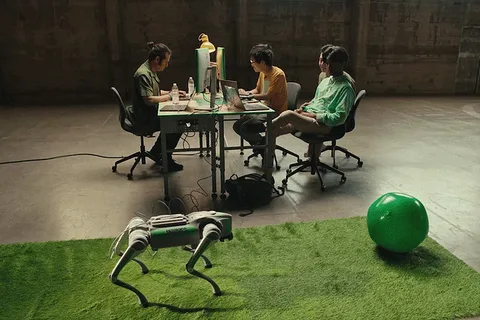
AI technologies have begun to surpass human capabilities not only in writing text and code but also in performing complex tasks in the physical world. A new stage of the Project Fetch experiment conducted by Anthropic showed that the Claude Opus 4.7 language model acts dozens of times faster and more efficiently than inexperienced operators in controlling robotic devices. This is reported by Ixbt.com news reports. In the first stage of the experiment, specialists compared the efficiency of teams working with and without the help of the Claude Opus 4.1 model. At that time, groups acting with AI assistance had a significant advantage in connecting sensors, configuring control controllers, and creating autonomous movement programs. However, the model had not yet achieved full independence and required human assistance in the basic stages of engineering. In the recently conducted second stage, the Claude Opus 4.7 model was tested under conditions of partial autonomy. The results are astonishing: the new model independently created the software solutions necessary to control the robot. The human's role was limited to connecting the computer, entering the initial request, and confirming commands. According to ixbt.com, Claude Opus 4.7 performed tasks at least 10 times faster than any human team from the first stage. Unprecedented Speed of AI According to researchers' calculations, if only the specific tasks performed by both groups (humans and AI) are considered, the speed of the Claude model was 37 times higher than humans not using AI, and 18 times higher than teams working in collaboration with it. Most interestingly, the amount of code generated by the model was nearly ten times less than the code written by humans, proving it to be much more concise and efficient. It is worth noting that this achievement is not the result of special optimization for the field of robotics. According to Anthropic experts, such an increase in efficiency is linked to the general scaling of the models, i.e., the increase in their intellectual capacity. This trend was previously observed in programming and cybersecurity: first, the model enhances human ideas, then the human assists the model, and finally, the model begins to operate independently in a new environment. Existing Shortcomings and Future Prospects Although the results are impressive, the project authors state that the robotics issue is not fully resolved. The Claude model still faces difficulties in controlling the robot's movements with millimeter precision, especially in the task of returning a ball to a designated area (fetch). Sometimes the system chose suboptimal algorithms for object recognition and failed to ensure the stability of the movement trajectory. The model cannot yet match human intuition in complex feedback systems; Errors are observed in continuously correcting movements based on signals from the environment; Currently, the system shows high efficiency only at the software level. In conclusion, the Anthropic experiment showed that the interaction of AI with physical robots has reached a new stage. Soon, these technologies are expected to significantly ease human labor or completely replace it in manufacturing, logistics, and service sectors.
Source: Zamin.uz