



By @IntEngineering, Jijo Malayil
Jun 15, 2026
Atlas demonstrates general intelligence needed for industrial tasks
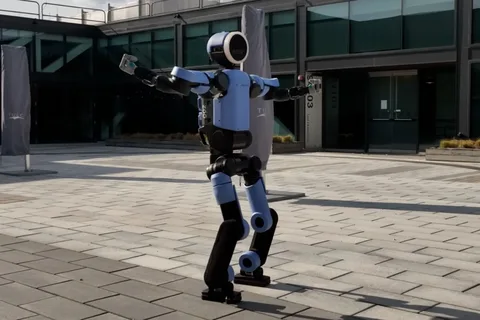
New reports suggest that Boston Dynamics’ Atlas is approaching the autonomy needed for industrial deployment. The assessment follows recent demonstrations by Boston Dynamics that indicate significant progress in developing general intelligence. Experts suggest advancements now enable humanoid robots to adapt to unfamiliar environments and perform a broader range of tasks beyond preprogrammed actions. Recently, the US robotics firm launched a campaign featuring Atlas, using football to showcase human-centered robotics, AI, and human-robot interaction. Atlas gains intelligence Boston Dynamics is making rapid progress toward commercializing humanoid robots, with its Atlas platform approaching the level of autonomy required for industrial deployment, according to a new report from KB Securities. Analyst Kang Sung-jin said recent demonstrations by Boston Dynamics, Hyundai Motor Group’s US-based robotics subsidiary, point to major advances in the development of humanoid robot “general intelligence” — the ability to adapt to unfamiliar environments and perform a broad range of tasks without relying solely on preprogrammed instructions, reports The Korean Herald (TKH). A key factor behind this progress is the company’s accelerated training framework. According to the report, Boston Dynamics can run simulations equivalent to millions of hours of robot training in a single day. The resulting behaviors and skills can then be transferred to a physical Atlas robot in roughly one hour, significantly shortening development cycles and enabling faster deployment of new capabilities. The report credits strategic collaborations with Google DeepMind and Nvidia for helping drive these advancements. DeepMind contributes expertise in artificial intelligence and learning systems, while Nvidia provides the high-performance computing infrastructure needed for large-scale simulation and robot training. Recent Atlas demonstrations also highlight notable improvements in physical intelligence and whole-body control. In one example, the humanoid robot moved a refrigerator using coordinated movements across its entire body, while another video showed Atlas performing dynamic kicking motions that required balance, agility, and precise motor control, reports TKH . Kang said the demonstrations reinforce Hyundai Motor Group’s commitment to industrial humanoid robotics and position Boston Dynamics as a leading contender in the emerging market. He projects the company could secure 15 percent of the global humanoid robot market by 2035 and as much as 60 percent of the premium industrial humanoid segment. Atlas industrial leap Boston Dynamics says one of the key advantages of its new Atlas humanoid robot is a significantly reduced “sim-to-real gap” — a common robotics challenge where skills learned in simulation fail to transfer reliably to the physical world. The company attributes this improvement to Atlas’ simplified hardware design, which makes it easier to create highly accurate simulations for training. Unlike many humanoid robots that use numerous actuator types and complex mechanical systems, Atlas relies on just two actuator types across its body. Its arms and legs are also designed symmetrically, simplifying both control and simulation. This streamlined architecture allows engineers to train the robot more efficiently in virtual environments and rapidly transfer those capabilities to the real machine. Boston Dynamics also redesigned Atlas to eliminate cables running across joints, enabling continuous joint rotation while reducing wear and maintenance requirements. The added flexibility allows the robot to perform movements that are difficult for conventional humanoids. The company highlighted Atlas’s ability to handle heavy industrial tasks. Although the robot was trained using loads weighing between 50 and 70 pounds (23–32 kilograms), it successfully moved a refrigerator weighing more than 100 pounds (45 kilograms) during testing. According to Boston Dynamics, such tasks require more than visual perception, demanding full-body coordination, weight anticipation, balance, and precise force control. The company added that Atlas’s athletic feats, including handstands and backflips, serve a practical purpose by helping develop balance, agility, slip recovery, and endurance needed for real-world industrial environments.
Source: Interesting Engineering