



By @IntEngineering, Jijo Malayil
May 25, 2026
Chinese firm launches a humanoid robot for daily house chores
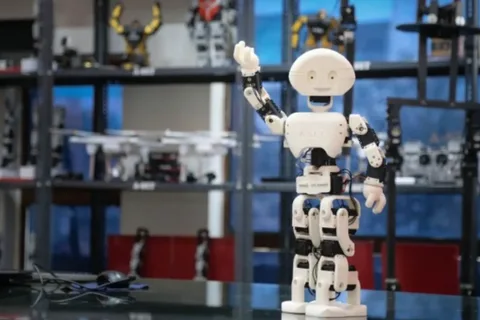
Chinese tech firm GigaAI has unveiled what it describes as the first commercial robotic butler, the SeeLight S1. The company says the initial 100 pilot units will be deployed at the end of this month in employee homes. It plans a wider rollout in Wuhan, offered free of charge, in the first half of 2027. Officials frame the initiative as part of long-term efforts to boost automation and support aging population needs nationwide, according to reports. Last year, Midea Group showcased a humanoid butler robot prototype capable of voice interaction, handshakes, gestures, dancing, and basic tool-use tasks. AI butler emerges GigaAI is a startup founded in 2023 and backed by Huawei’s investment arm. The system has been created in collaboration with state-supported robotics research organizations, including the Hubei Humanoid Robot Innovation Centre and the Hubei Humanoid Robotics Industry Alliance. The SeeLight S1 is a two-armed, wheeled humanoid robot that the company describes as the first general-purpose home robot. In demonstrations, it has been shown performing a range of domestic tasks, including chopping vegetables, frying eggs, loading a washing machine, hanging laundry, making a bed, and opening curtains, according to Fast Company. It operates using embodied AI, described as a system where a digital “brain” is directly connected to a physical body, enabling it to perceive its surroundings and make decisions without step-by-step human instructions. According to company statements, the SeeLight S1 is expected to be priced at around $15,000 when it is released in retail markets in June 2027. The company plans to begin free S1 deployments in Wuhan homes in the first half of 2027, prioritizing families with elderly members, children, or pets for the initial pilot program. Domestic robot race S1 is positioned as one of the proposed responses to China’s ongoing demographic challenges, alongside a broader policy push encouraging the deployment of embodied AI across everyday environments where needed. Unlike traditional industrial robots that rely on fixed programming for repetitive factory tasks, S1 is said to use an embodied intelligence model. This allows it to understand task objectives, plan its own movements, and improve performance in real domestic settings over time, reports Shia Waves. Safety is also a key focus. Reports from Hubei media state that the robot features a compliant control system that immediately stops its motion upon contact with a person or pet, making it more suitable for safe operation in family homes. According to experts, real-world deployment of such robots presents significant challenges. Home environments are highly unstructured and vary widely, requiring robots to navigate constantly changing, complex three-dimensional spaces. Unlike simpler cleaning robots that operate in limited two-dimensional areas, a dual-arm humanoid system must handle dynamic obstacles and unpredictable layouts, making reliable autonomy in domestic settings considerably more difficult. Reports suggest that efforts to close the domestic data gap are emerging as a parallel industry focus. Shenzhen-based OneRobotics, which was listed in Hong Kong in December, recently announced a 45 million yuan agreement to collect embodied AI training data across household environments, including elder care and retail settings. The company plans to deploy its OneRo H1 robots to gather real-world data in kitchens, bedrooms, bathrooms, and balconies, areas considered high-frequency task spaces that remain underrepresented in current robotics datasets, reports Robots Beat. Meanwhile, the global household robot market was valued at about $41 billion last year, largely driven by robotic vacuum cleaners, and the market is expected to grow around 20 percent annually through 2027.
Source: Interesting Engineering