



By @IntEngineering, Jijo Malayil
Jun 18, 2026
Codey represents new era of autonomous, socially intelligent humanoids
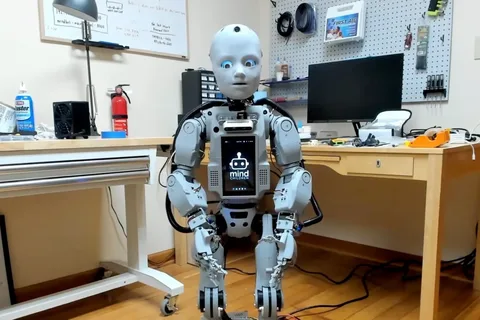
Codey operates independently, using sensors, onboard computing, and AI to navigate, understand, and interact in real time. Codey is an autonomous humanoid robot designed to understand, assist, and interact with people. A Seattle-based robotics company has developed a three-foot-tall humanoid robot designed for use in public attractions and venues. The AI-powered robot named Codey can navigate autonomously, engage in conversations without remote human control, and make independent decisions. While not yet capable of performing complex physical tasks such as fetching objects, Codey is being developed for future roles in healthcare, education, and hospitality. The company says the robot is designed to interact naturally with people, particularly children, in public-facing environments. Codey targets companionship Codey is designed to serve as an interactive companion in public-facing environments. Standing about three feet tall, the robot features glowing hazel eyes, expressive facial animations, and a friendly appearance intended to engage users, particularly children. Powered by AI, Codey can navigate autonomously, hold conversations, and make basic decisions without requiring a remote human operator. Unlike many robots that rely heavily on teleoperation, Codey is designed to function independently, enabling more natural and responsive interactions with people. The robot uses a combination of sensors, onboard computing, and AI software to understand its surroundings and communicate with users in real time. Mind Children plans to conduct pilot studies this year in museums, hotels, and art galleries to gather data and refine Codey ahead of mass production. One of the company’s near-term objectives is to enable the robot to perform simple physical tasks, such as pressing buttons. A second-generation version of Codey is scheduled for release in 2027. To support development, Mind Children has launched a crowdfunding campaign and has raised more than $600,000 toward its $1 million funding target. In the longer term, Codey is expected to be introduced into healthcare, education, and hospitality settings. Potential applications include assisting visitors with information, providing companionship, supporting learning activities, and helping organizations deliver more engaging customer experiences. Embodied AGI advances At the core of Mind Children’s robotics platform is Hyperon, the decentralized artificial general intelligence (AGI) framework developed by SingularityNET. The system is designed to give robots advanced cognitive capabilities that go beyond traditional rule-based automation, enabling them to reason, learn, adapt, and make decisions in dynamic real-world environments. By integrating Hyperon into its humanoid robots, Mind Children aims to create machines capable of understanding context, processing complex information, and responding more naturally to human interactions. The framework incorporates knowledge representation, reasoning engines, and human-inspired motivation systems that help robots prioritize tasks, pursue goals, and adapt their behavior based on changing circumstances. This approach is intended to move robots closer to exhibiting flexible, human-like intelligence rather than performing only pre-programmed actions. Unlike conventional AI systems that rely on centralized computing and data control, Hyperon operates within SingularityNET’s decentralized ecosystem. This architecture allows AI services, knowledge resources, and computational capabilities to be distributed across a network, promoting collaboration, scalability, and interoperability among different AI agents and robotic platforms. The partnership between Mind Children and SingularityNET positions the company among the first developers pursuing embodied decentralized AGI—an emerging field that combines advanced artificial intelligence with physical robotic systems. The goal is to create autonomous robots capable of perceiving, reasoning, learning, and interacting with the physical world while continuously improving their capabilities through decentralized intelligence networks.
Source: Interesting Engineering