



By Sebastian Ariel Barros, Sebastian Barros
Jun 01, 2026
GPU is not the end game in AI, but biological neurons
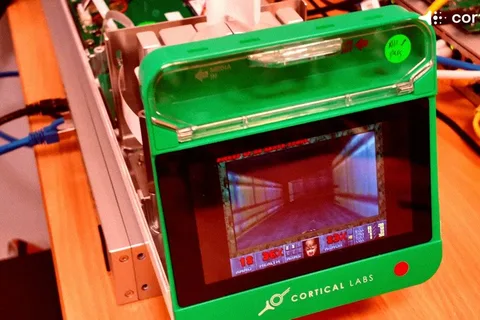
This week, Cortical Labs achieved a milestone that sounds like absolute mad-man science fiction, although it is grounded in very real hardware, as they successfully trained a biological computer, an experimental system in which living neurons serve as processors, running on 200,000 lab-grown human neurons to play Doom. What makes this truly wild is the accessibility. You don’t even need a sterile bio-lab to use it. These living, cultivated human brain cells are networked via the Cortical Cloud. This is a “Wetware-as-a-Service” platform that lets developers run standard Python code directly on biological tissue via a web browser. A company is proactively building a remote, cloud-accessible AI infrastructure using living human tissue. The technical achievement is wild, but the historical parallel makes it truly iconic. 30 years ago, Nvidia was building silicon accelerators so gamers like me could push frame rates in PC games like Quake. They used parallel computing to render 3D graphics. They were completely unaware that this same silicon architecture would become the essential engine for trillion-parameter deep learning models a few decades later. If you spent entire weekends in the 90s staring at a screen playing Quake, congratulations: you were an angel investor. We thought we were just buying 3D accelerators for better frame rates, but we were actually crowdfunding the exact parallel silicon architecture that powers modern AI Intelligence Factories. We are standing at a similar inflection point today. It is becoming mathematically clear that silicon is not the endgame for the AI Inference Economy, and neither are GPUs. In the 90s, kids inadvertently stress-tested the future of digital AI by hunting demons in Quake using Nvidia graphics accelerators. Today, 200,000 biological neurons are playing the same game to prototype the next era of computing. Sometimes life feels like a simulation. When you consider the heavy thermodynamic cost of scaling today’s centralized data centers, shifting from brute-force silicon to biological efficiency could make sense. This holds true regardless of the engineering hurdles we will face along the way, which, by the way, are many! Right now, the AI industry is trying to scale the Inference Economy through sheer brute-force physical infrastructure. We are building massive Intelligence Factories, warehouses packed with tens of thousands of GPUs, drawing gigawatts of power, and requiring industrial-grade liquid cooling just to prevent the silicon from melting. This energy-to-compute ratio is hitting a hard thermodynamic wall. Cortical Labs is attacking this constraint not with smaller transistors, but with biology. And to be clear, this is not some abstract sci-fi concept but in grounded, commercial hardware. Their flagship platform, the CL1, is the world’s first code-deployable biological computer. But building a machine out of living tissue requires a completely different architecture. This is Cortical Labs CL1. Inside this box there are around 200,000 living human neurons on a microchip.
Source: Sebastian Barros Newsletter