



By @IntEngineering, Jijo Malayil
Jun 19, 2026
New robot plugs moving wires with 99.5% accuracy in factory test
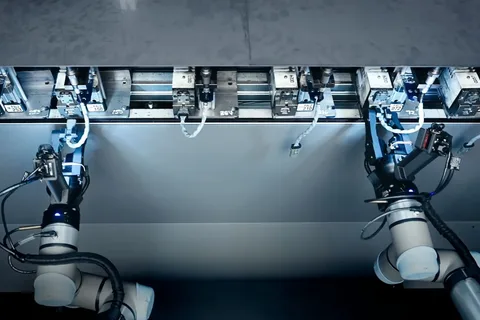
Canadian robotics company Sanctuary AI has reported a significant achievement in industrial automation. The firm said its system achieved a task success rate of more than 99.5 percent during a complex wire-plugging task for a global Tier 1 automotive supplier. The operation completed in 2.54 seconds, meeting the customer’s live-production benchmarks and demonstrating high-speed, reliable performance in a manufacturing setting. Sanctuary AI said the milestone highlights its strategy of deploying Physical AI on commercial robots to speed industrial adoption and support future industrial humanoids. Factory automation leap The achievement reflects Sanctuary AI’s strategy of deploying its Physical AI platform on existing and next-generation industrial robotic systems, rather than waiting for widespread commercialization of humanoid robots. This hardware-agnostic approach enables the company’s AI models to operate across different robotic platforms while accelerating adoption in manufacturing environments. Sanctuary AI demonstrated high-performance Physical AI capabilities in an industrial manufacturing environment, achieving a task success rate exceeding 99.5 percent in a complex wire-plugging operation for a global Tier 1 automotive supplier. The system completed the task with a cycle time of 2.54 seconds, matching the throughput requirements of the customer’s live production line and meeting established industrial performance benchmarks. The deployment focused on a plug-insertion process involving flexible wire assemblies moving along a conveyor. Such tasks are particularly challenging for automation because the cables can bend, twist, and shift position dynamically during transport, requiring continuous perception, adaptation, and precise manipulation. According to the firm, the AI -powered robotic system successfully detected, tracked, aligned, and inserted the connectors while maintaining production-line speed and reliability. “Manipulating a flexible wire into a moving target on a live conveyor is exactly the kind of contact-rich dexterity problem that has kept tasks like this out of reach for traditional automation. Solving it required models built around performance from day one with reliability, cycle time, and safety measured against real production benchmarks,” said Olivia Norton, co-founder and CTO of Sanctuary AI, in a statement. AI power industries Sanctuary AI develops Physical AI systems designed to enable robots to perform complex tasks in real-world industrial environments. Unlike traditional industrial automation, which relies on fixed programming for repetitive operations, Sanctuary AI’s approach combines advanced perception, reasoning, and manipulation capabilities, allowing robots to adapt to changing conditions and handle tasks that require dexterity and decision-making. The company’s Physical AI platform processes information from cameras, sensors, and robotic actuators to understand its surroundings and execute actions in real time. This enables robots to identify objects, track movement, plan motions, and manipulate components with a high degree of precision. The technology is particularly suited to manufacturing environments where variations in object position, orientation, or movement make conventional automation difficult. A key feature of Sanctuary AI’s strategy is its hardware-agnostic design. The AI can be deployed on existing industrial robotic systems as well as future robotic platforms, reducing the need for specialized hardware. This allows manufacturers to integrate advanced AI capabilities into current production lines while preserving existing infrastructure investments. The platform is designed to automate labor-intensive tasks, including assembly, material handling, inspection, and component insertion. By combining real-time perception, motion planning, and adaptive control, Sanctuary AI aims to help factories improve productivity, maintain consistent quality, address labor shortages, and prepare for the next generation of intelligent industrial robots. “By focusing on a performance-first approach to Physical AI models, we’re delivering value to customers today, on an AI platform that will also scale to the next generation of general-purpose systems,” said Norton, in a statement.
Source: Interesting Engineering