



By Russell Flannery
Jun 16, 2026
Should The U.S. Follow China’s Auto Industry Playbook?
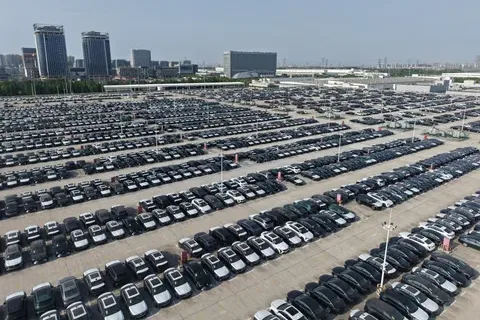
New cars are ready to be launched at a SAIC General Motors joint venture production base in China in last year. (Photo credit should read CFOTO/Future Publishing via Getty Images) CFOTO/Future Publishing via Getty Images Big increases in China’s auto exports including a doubling of global EV shipments last month underscore a truth that is lacking in U.S. discussion about the future of its own auto industry: Chinese cars “are not going away,” particularly EVs that “have better technology and better features at a better price,” according to long-time China business expert Ker Gibbs. “That is a fact. The question is, what are we going to do about it?” asked Gibbs, author of newly published The Fragile Dragon: Trade, Trump, and China’s Vulnerabilities . “We should be running the China model of demanding foreign investment (in its auto industry) in reverse. Why not learn from China? It worked for them.” The former chairman of the American Chamber of Commerce in Shanghai is currently an executive-in-residence at the University of San Francisco’s Center for Asia Pacific Studies; he spoke from San Francisco in a Zoom interview. “The current strategy of just throwing up a wall” to keep out Chinese autos isn’t workable in the long run for the U.S., he said. Once-poor China has turned itself into the world’s largest automaker and car market since the start of economic reforms in the 1980s. The country early on worked to link market access to joint ventures that would transfer technology or provide other commercial benefits; multinational automakers such as GM and Volkswagen helped China with joint ventures with the likes of state-owned partners such as SAIC and FAW. Other types of government policy support are credited with helping private sector businesses such as BYD over the years. “BYD, Nio and Xpeng have fabulous cars, and export markets are very interested in having those vehicles -- everywhere except for the United States.“ Yet excessive policy support has been blamed for “ involution ” and huge supply-demand imbalances in the country. Current Approach Won’t Work In The Long Run The current Trump administration approach to rely on tariffs to discourage imports that tend to wall off China EVs won’t work, Gibbs said. “For one thing, the wall is porous. We have land borders with Mexico and Canada. Thousands of vehicles are driven across both of those borders every single day. Canada is importing 49,000 Chinese electric vehicles,” he said. “There's a discussion about how to keep those vehicles out of the U.S., but it will not work. My prediction is within a year a third of those vehicles are going to find their way onto U.S. highways.” MORE FOR YOU “Throwing up the wall is not a long-term strategy. It will protect the U.S. auto industry temporarily, but that's not a formula for how to catch up or how to build a healthy industry in the long term,” Gibbs said. “I think we need a much more nuanced and more strategic approach to the problem.” The U.S. “can invite Chinese EV manufacturers to come invest in the United States, build their vehicles here, bring their technology here, and abide by U.S. laws and requirements on data and software.” “When Tesla started selling cars in China, and people figured out how much data they were collecting, the government freaked out,” he noted. ”Elon Musk flew to Beijing, and they agreed to redesign the car. If they could figure out a solution, why can’t we?” Employees on a production line for Tesla Inc. Model Y electric vehicles at the company’s Gigafactory plant during a media tour in Shanghai in April. Tesla faces relentless competition in China from high-tech domestic rivals such as BYD. Photographer: Qilai Shen/Bloomberg © 2026 Bloomberg Finance LP China over the years “demanded the technology transfer. They set the terms for how Chinese workers would be hired and what their benefits would be. And they used that strategy to develop their own industry” and compete against foreign firms, Gibbs said. “That was always part of the plan. And sure enough, what we've got right now is local firms and local brands in China now dominating the market. They have almost 70% share of their own domestic market.” U.S. Shouldn’t “Sit Around and Whine” “And more to the point, BYD is selling more vehicles than Tesla globally. So, it's a successful strategy. Rather than sit around and whine and complain about it, I think we should copy it,” Gibbs said. Pushback in the U.S. from defenders of the status quo needs to be addressed in terms of a national economic interest in being able to compete globally and offering fair prices at home, he said. “BYD has a fully electric SUV on the market right now for $12,000 in China. The equivalent vehicle in the United States sells for $33,000. If our strategy is to just put up the wall and keep those vehicles out, then American consumers will be deprived of the best possible product with the best possible features. And American consumers will end up paying a lot more. Is that what we want? Is that a winning formula to strengthen our auto industry?” Gibbs thinks Chinese firms would likely be willing to invest. “It depends on what the terms are, but why wouldn’t then? The United States is the most attractive vehicle market in the world. It's high profit and high volume, which is a nice combination.” What’s more, investing in manufacturing overseas rather than focusing so much on exports could lower the pressure China faces from trading partners unhappy with its large trade surplus. “Not all those trading partners have the strength or inclination to push back against China the way the United States has. But ultimately, I think they all have to fix and balance their trade relationships.” “As I mentioned in my book (The Fragile Dragon ), one of China's fundamental weaknesses is its trading relationships, not just with the United States and on this particular issue, but with Europe as well and most countries. You have to look at the trade surplus that they run with most countries in the world.” American firms would catch up with China in a more competitive environment with clear, enforced rules, Gibbs believes. “I believe in American ingenuity. There’s no reason that we would not be able to catch up. And I believe that by working with China, rather than putting up walls, we will get there faster and better.
Source: Forbes