



By News Desk
Jun 01, 2026
Spiro raises $215 million to expand Africa's electric motorcycle network
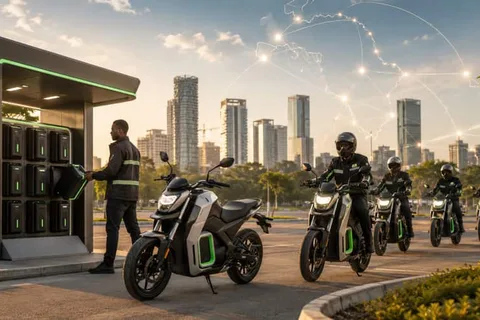
Spiro's $215 million raise shows that African electric mobility is moving from pilot projects into infrastructure-scale competition. Spiro has just put one of Africa's biggest clean-mobility bets back in front of investors. The electric motorcycle company raised $215 million in equity financing on June 1, giving it fresh capital to expand battery swapping, vehicle assembly and energy infrastructure across the continent. That matters because the African EV story is not really about private cars. It is about motorcycles, delivery riders, urban transport and the cost of fuel. In many African cities, two-wheelers are not lifestyle products. They are working assets. If a rider can lower daily operating costs without waiting hours for a battery to charge, the economics become very practical very quickly. According to the Associated Press, the round was backed by institutional investors from Europe and Africa, including Impact Fund Denmark. A company announcement also named Equitane among the backers, and said the raise follows a year in which Spiro moved deeper into battery swapping, local manufacturing and energy infrastructure. The company has not disclosed the valuation attached to the new round, which is important. The funding size is large enough to put Spiro in the conversation with Africa's most heavily backed mobility startups, but the absence of a disclosed price means the market should be careful about treating this as a confirmed unicorn moment. Spiro's main idea is simple. Riders use electric motorcycles and swap depleted batteries at dedicated stations instead of charging them at home or losing working hours at a plug. The company says it has deployed more than 100,000 electric motorcycles and built about 2,500 smart-swap stations across Kenya, Rwanda, Uganda, Togo, Benin, Nigeria and Cameroon. That battery-swap model reduces one of the biggest barriers to EV adoption in emerging markets: the upfront cost and inconvenience of energy access. A motorcycle rider does not need to own the most expensive part of the vehicle in the same way, and Spiro can turn the battery network into recurring revenue rather than relying only on vehicle sales. This is why comparisons with Asian battery-swapping companies such as Gogoro are useful, but only up to a point. The basic logic is similar. Put enough stations in the right places, make swaps fast, and turn energy into a service. But Africa's opportunity has its own shape. Grid reliability, fuel import dependence, informal transport networks and rider financing all make the execution problem more local and more complex. Spiro says riders can cut daily transport costs by up to 40%, with savings of as much as $2 per day compared with gasoline motorcycles. That may sound small to investors looking at billion-dollar markets, but for commercial riders it can be the difference between a thin day and a profitable one. This is where the climate story and the income story meet. Infrastructure is the expensive part The new money will go into battery-swapping network expansion, local manufacturing and assembly, technology development and entry into markets including the Democratic Republic of Congo and Ethiopia. Spiro already operates manufacturing plants in Kenya, Rwanda and Uganda, along with a battery recycling facility in Nigeria. The company also says its technology platform is supported by an R&D center, more than 150 engineers and over 30 patents. That mix shows why the business is capital intensive. Spiro is not just importing motorcycles and hoping adoption follows. It is trying to build the physical and software layer around them: stations, batteries, maintenance, data systems, assembly lines and eventually solar-powered swap stations and second-life battery storage. There is a reason investors are willing to fund that complexity. Southeast Asian EV markets are already crowded with major scooter brands, battery networks, super apps and logistics operators. Africa is earlier, less saturated and still forming its infrastructure winners. If Spiro can establish station density before rivals reach scale, it could become difficult to dislodge in key cities. Spiro has also been adding engineering depth, not just capital. TechCabal reported that the company recently acquired Coexlion, a two-wheeler and EV engineering consultancy with offices in the United Kingdom and India, and plans to build an R&D center in Kenya. That matters because motorcycles built for African commercial riders need to handle heat, rough roads, heavy use and maintenance realities that imported designs do not always solve well. Still, the harder questions have not disappeared. Battery networks need utilization. Manufacturing needs consistent demand. Rider financing has to work through fuel price cycles, currency pressure and maintenance realities. Companies such as Ampersand, Roam and BasiGo are also building in the wider electric mobility market, so Spiro is not running alone. What makes this round worth watching is that institutional capital is moving toward the infrastructure layer of African startups, not only software marketplaces or fintech rails. For years, the easy argument was that African venture capital had to stay asset-light. Spiro is testing the opposite view: that in some markets, the company willing to own the hard parts may own the margin later. The next signal will not be another headline funding number. It will be whether Spiro can increase swaps per station, keep riders saving money and expand into new countries without letting operational complexity outrun demand. If it can do that, this raise will look less like a one-off climate tech splash and more like a marker for where African mobility capital is heading next.
Source: Startup Fortune