



By News Desk
Jun 02, 2026
The university campus is fiercely divided, with California State University pouring $16.9 million (a..
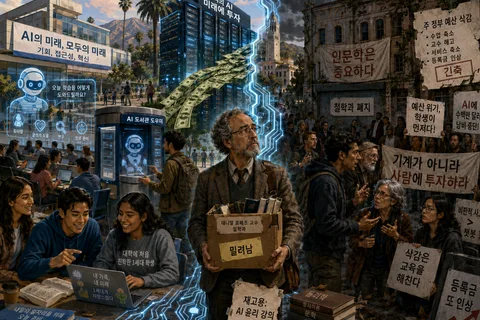
By pouring money into the 'AI Everywhere' project President, some students, in favor of 'securing competitiveness Union, opposition, waste of budget, and corporate subjugation It illustrated the controversy over the introduction of AI at California State University. [Chat GPT] The university campus is fiercely divided, with California State University pouring $16.9 million (about 25.5 billion won) into the introduction of artificial intelligence (AI) amid a severe financial crisis. Management's praise of essential innovation for future jobs and members' criticism of wasting budgets accelerating the collapse of public education are fiercely confronting. The New York Times (NYT) reported in-depth the controversy surrounding the ambitious "AI Everywhere" project of the largest four-year public university in the United States, the University of California (CSU). With the future of education reshaped by technology in Silicon Valley, the huge experiment is causing havoc on campus, analysts say. "AI Everywhere" was achieved through a large-scale contract with OpenAI, which distributes 500,000 ChatGPT student licenses to students and faculty. AI library librarians were introduced throughout the campus, and required orientation included AI literacy education. Presidents and California Governor Gavin Newsom, who call themselves the "CEOs" of universities, argue that the project will nurture students into "the AI workforce of the future." About half of CSU students are Hispanic, and many are the first first-generation immigrants in their families to go to college. The university says it will be a strong ladder for class movement to help them not fall behind in the rapidly changing AI economy. The odd cohabitation problem between restructuring and AI is that this huge AI investment came at exactly the same time as the university system's $2.3 billion deficit, massive faculty layoffs, department consolidation, and a 6% tuition increase. San Francisco State University Professor Masakeney said, "We are seeing AI coming into the education ecosystem, which has already been weakened by austerity measures. In Silicon Valley terms, it's like a devastating "force multiplier," he said. The response on campus is starkly mixed. Some students, including Keith Curry, a 33-year-old late college student, are applying for AI internships, learning prompt engineering voluntarily and actively embracing technology. On the other hand, while liberal arts departments are being abolished, there are many voices of opposition, saying that only for-profit companies are becoming full. Some students protested against classes forcing the use of AI, and thousands of faculty members joined a signature-collecting campaign against contract extensions. The difference in perspective surrounding the introduction of AI on campus is clear. The "yes" such as management and some students are in favor of preparing for future jobs and improving productivity. Their rationale is to secure employment competitiveness through technology adaptation and expectations for class movement. The "opposition" such as unions and student protesters are fiercely opposed, citing budget waste, decreased critical thinking, and ethical issues. Humanities faculty and some students are concerned about the reduction of humanities and subordination of private companies amid the financial crisis. There are also moderates. Those who claim to be experimental prisoners insist on acknowledging reality and using it as an educational tool. Recently, CSU System announced that it will extend its partnership with OpenAI to $13 million (about 19.7 billion won) over three years despite criticism. A condition was added to help graduates get a job by maintaining AI access for one year, and students' options were expanded so that they would not be forced to a single platform. It is still unclear how AI will change the identity of California's public education. Professor John Sulins of Sonoma State University lost his job after the philosophy department was merged, but was later re-appointed as a professor of "AI ethics" in the computer science department. His wonderful case encapsulates the current chaos at the university. Professor Sulins asks. "With destruction comes recovery all the time. But the real question is this. How far will this destruction go?"
Source: 매일경제