



By Eric Ralls
May 28, 2026
Thousands of hidden planets found in old NASA telescope data
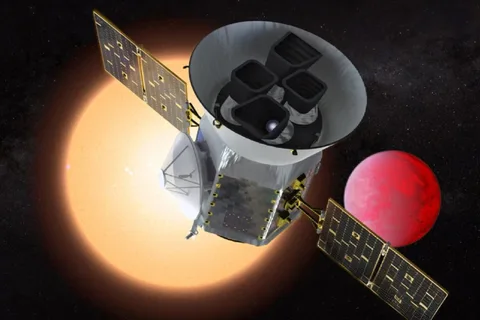
A sky-survey satellite completed its first year of data collection in 2018, capturing brightness records for tens of millions of stars. Astronomers worked through the brighter targets and moved on to confirming worlds. Most of what the spacecraft had recorded just sat in the archive – millions of brightness records, sitting unexamined for years. A team recently built tools to search through all of the records. The number of hidden planet candidates they found turned out to be far beyond what the field had predicted. NASA’s TESS telescope, short for Transiting Exoplanet Survey Satellite, has been scanning the sky since 2018. TESS watches stars for tiny, repeating dips in brightness, the telltale shadow of a planet crossing in front of its host star. Over its full run, the satellite has flagged close to 8,000 planet candidates. Most of them sit around stars bright enough to follow up easily. The faint end of the catalog has stayed thin. Joshua T. Roth, a graduate student in the Department of Astrophysical Sciences at Princeton University, led the new search. Roth and his colleagues suspected far more planets were still buried in that faint end of the catalog. They built a pipeline around machine learning and turned it on TESS’s first year of data. The numbers came back larger than anyone expected. The search turned up 11,554 planet candidates — 10,091 never seen before. Looking past bright stars Light from a faint star is messy. Cosmic ray impacts, the occasional glitch in the instruments, and the slight wobble of the spacecraft all leave fingerprints on the brightness record. Most TESS searches focus on stars brighter than about 13th magnitude. That cap was leaving real planets on the table. An earlier paper by the same group built clean light curves – brightness records taken over time – for every TESS star down to 16th magnitude, many times fainter than the usual search list. The result was a mountain of data: roughly 84 million brightness records across some 54 million stars. A single question drives the work. How many of those squiggles carry the faint, repeating signature of a world crossing in front of its star? Distinguishing planets from impostors Roth’s group built software that learns to sort. They used a random forest classifier – a voting system where independent programs each assess whether a brightness record shows a planet, an eclipsing star pair, or simple noise. Training mattered just as much as the design. The team fed the system thousands of confirmed planet signals, real eclipsing binaries from a published catalog, and simulated transits inserted into actual data. Over time, the algorithm learned how to distinguish real planets from impostors. One model was not enough. The signal from a bright star looks different from a faint one, and a single classifier kept losing accuracy at the dim end. The team trained two separate classifiers. One handled the brighter stars, while the second focused on the noisier, fainter records where the researchers expected most undiscovered planets to be hiding. A confirmed hot Jupiter Sorting that many signals leaves a real worry. How many are not actually planets? To find out, the group picked one promising candidate and chased it with the Magellan telescope in Chile. The follow-up confirmed a hot Jupiter – a gas giant orbiting its star in days. Its host turned out to be an old, metal-poor star in the Milky Way’s thick disk, formed when the galaxy’s heavy elements were scarce. This is an unusual home for a planet that size. Roth told reporters that he expects between 3,000 and 5,000 of the new candidates to survive closer scrutiny as real planets. That alone would be one of the largest boosts to the known planet count since TESS began. Doubling the catalog The 411 single-transit events in the new list are intriguing on their own. The satellite caught only one dip for each, so the orbital period is unknown. Many are likely longer-period worlds that future TESS runs will pick up. Many of the new candidates stretch outward. Some sit around stars roughly 6,800 light-years away, deep toward the Milky Way’s center. That distance roughly doubles the volume of space the mission had been mining for transits. Orbital periods run from 12 hours up to about 27 days. That window catches close-in gas giants easily, and leaves true Earth-like planets, with their long slow orbits, out of reach. Future research directions Until this work, the idea that thousands of planets were hiding in faint TESS data lived only in forecasting papers. The new search puts the answer in real numbers. A well-trained classifier can pull planet signals out of records too noisy for human teams. For astronomers, that opens a different kind of map. The James Webb Space Telescope and the next generation of giant ground-based observatories now have a far larger menu of targets, including small, faint, distant worlds that never appeared on previous lists. The catalog gives theorists their first close look at planets around the dimmer half of nearby stars. Trends in how planets form and survive around faint, metal-poor stars can now be tested against a sample that finally includes them. The study is published in The Astrophysical Journal Supplement Series.
Source: Earth.com