



By han, Xiaodong
Jun 02, 2026
Van der Waals strain hardening and large uniform tensile elongation in GaSe
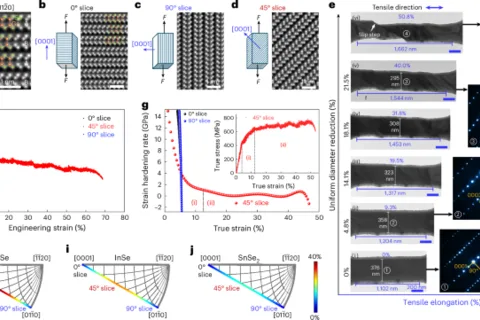
Data availability The data that support the findings of this study are available from the corresponding authors upon request. Source data are provided with this paper. References Devarakonda, A. et al. Evidence of striped electronic phases in a structurally modulated superlattice. Nature 631 , 526–530 (2024). Article CAS PubMed Google Scholar Lu, D. et al. Monolithic three-dimensional tier-by-tier integration via van der Waals lamination. Nature 630 , 340–345 (2024). Article CAS PubMed Google Scholar Dirnberger, F. et al. Magneto-optics in a van der Waals magnet tuned by self-hybridized polaritons. Nature 620 , 533–537 (2023). Article CAS PubMed Google Scholar Pramanik, N. et al. Fundamental scaling laws of water-window X-rays from free-electron-driven van der Waals structures. Nat. Photon. 18 , 1203–1211 (2024). Article CAS Google Scholar Ghazi Sarwat, S. et al. An integrated photonics engine for unsupervised correlation detection. Sci. Adv. 8 , eabn3243 (2022). Article PubMed PubMed Central Google Scholar Kajale, S. N., Nguyen, T., Hung, N. T., Li, M. & Sarkar, D. Field-free deterministic switching of all–van der Waals spin-orbit torque system above room temperature. Sci. Adv. 10 , eadk8669 (2024). Article CAS PubMed PubMed Central Google Scholar Liu, D. et al. Lattice plainification advances highly effective SnSe crystalline thermoelectrics. Science 380 , 841–846 (2023). Article CAS PubMed Google Scholar Zhou, C. et al. Polycrystalline SnSe with a thermoelectric figure of merit greater than the single crystal. Nat. Mater. 20 , 1378–1384 (2021). Article CAS PubMed PubMed Central Google Scholar Guo, Y. et al. Van der Waals polarity-engineered 3D integration of 2D complementary logic. Nature 630 , 346–352 (2024). Article CAS PubMed PubMed Central Google Scholar Sui, F. et al. Atomic-level polarization reversal in sliding ferroelectric semiconductors. Nat. Commun. 15 , 3799 (2024). Article CAS PubMed PubMed Central Google Scholar Wei, T. R. et al. Exceptional plasticity in the bulk single-crystalline van der Waals semiconductor InSe. Science 369 , 542–545 (2020). Article CAS PubMed Google Scholar Gao, Z. et al. High-throughput screening of 2D van der Waals crystals with plastic deformability. Nat. Commun. 13 , 7491 (2022). Article CAS PubMed PubMed Central Google Scholar Wang, H. Y. et al. Orientation-dependent large plasticity of single-crystalline gallium selenide. Cell Rep. Phys. Sci. 3 , 100816 (2022). Article CAS Google Scholar Deng, T. T. et al. Plastic/ductile bulk 2D van der Waals single-crystalline SnSe 2 for flexible thermoelectrics. Adv. Sci. 9 , 2203436 (2022). Article CAS Google Scholar Ge, B. Z. et al. Dynamic phase transition leading to extraordinary plastic deformability of thermoelectric SnSe 2 single crystal. Adv. Energy Mater. 13 , 2300965 (2023). Article CAS Google Scholar Cantos-Prieto, F. et al. Layer-dependent mechanical properties and enhanced plasticity in the van der Waals chromium trihalide magnets. Nano Lett. 21 , 3379–3385 (2021). Article CAS PubMed PubMed Central Google Scholar An, Z. et al. Negative mixing enthalpy solid solutions deliver high strength and ductility. Nature 625 , 697–702 (2024). Article CAS PubMed Google Scholar Sun, Y. D. et al. Van der Waals semiconductor InSe plastifies by martensitic transformation. Sci. Adv. 10 , eado9593 (2024). Article CAS PubMed PubMed Central Google Scholar Wong, L. W. et al. Deciphering the ultra-high plasticity in metal monochalcogenides. Nat. Mater. 23 , 196–204 (2024). Article CAS PubMed Google Scholar Blöchl, P. E. Projector augmented-wave method. Phys. Rev. B 50 , 17953 (1994). Article Google Scholar Ceperley, D. M. & Alder, B. J. Ground state of the electron gas by a stochastic method. Phys. Rev. Lett. 45 , 566–569 (1980). Article Google Scholar Barone, V. et al. Role and effective treatment of dispersive forces in materials: polyethylene and graphite crystals as test cases. J. Comput. Chem. 30 , 934–939 (2009). Article CAS PubMed Google Scholar Momma, K. & Izumi, F. VESTA 3 for three-dimensional visualization of crystal, volumetric and morphology data. J. Appl. Crystallogr. 44 , 1272–1276 (2011). Article CAS Google Scholar Ouyang, Y. et al. Accurate description of high-order phonon anharmonicity and lattice thermal conductivity from molecular dynamics simulations with machine learning potential. Phys. Rev. B 105 , 115202 (2022). Article CAS Google Scholar Lee, T. et al. Atomic-scale origin of the low grain-boundary resistance in perovskite solid electrolyte Li 0.375 Sr 0.4375 Ta 0.75 Zr 0.25 O 3 . Nat. Commun. 14 , 1940 (2023). Article CAS PubMed PubMed Central Google Scholar Schwaller, P., Vaucher, A. C., Laino, T. & Reymond, J. L. Prediction of chemical reaction yields using deep learning. Mach. Learn.: Sci. Technol. 2 , 015016 (2021). Google Scholar Iovanac, N. C. & Savoie, B. M. Erratum: improving the generative performance of chemical autoencoders through transfer learning. Mach. Learn. Sci. Technol. 2 , 39601 (2021). Article Google Scholar Mortazavi, B. et al. Exploring phononic properties of two-dimensional materials using machine learning interatomic potentials. Appl. Mater. Today 20 , 100685 (2020). Article Google Scholar Novikov, I. S., Gubaev, K., Podryabinkin, E. V. & Shapeev, A. V. The MLIP package: moment tensor potentials with MPI and active learning. Mach. Learn.: Sci. Technol. 2 , 025002 (2020). Google Scholar Plimpton, S. Fast parallel algorithms for short-range molecular dynamics. J. Comput. Phys. 117 , 1–19 (1995). Article CAS Google Scholar Li, J. AtomEye: an efficient atomistic configuration viewer. Model. Simul. Mater. Sci. Eng. 11 , 173–177 (2003). Article Google Scholar Download references Acknowledgements This work was financially supported from the National Science Fund for Distinguished Young Scholars under grant number 52125103 (X.Z.), the National Key Research and Development Program of China under grant numbers 2021YFA1200201 (X.H.) and 2023YFB3809500 (X.Z.), the Basic Science Center Program for Multiphase Evolution in Hypergravity of the National Natural Science Foundation of China under grant number 51988101 (X.H.), the National Natural Science Foundation of China under grant numbers 12595331 (X.Z.), 52071041 (X.Z.), 12104071 (X.Z.), 12374038 (Xiaolong Yang), 12574044 (Z.Z.), 12574006 (Jianfei Zhang) and 52301007 (J.L.) and the Fundamental Research Funds for the Central Universities under grant number 2023CDJKYJH006 (X.Z.). We are grateful for the support of the Multiscale Porous Materials Center of Chongqing University regarding the equipment in terms of material characterization. We would like to thank the Analytical and Test Center of Chongqing University and Bestron (Beijing) Technology Co. Ltd for providing technological support for the in situ tensile tests. We are grateful to H. Wu from Chongqing University of Posts and Telecommunications for providing the GaSe single-crystal samples. Author information Author notes These authors contributed equally: Sikang Zheng, Xiaolong Yang, Jianfei Zhang, Jiabao Zhang, Jingwei Li. Authors and Affiliations Institute of Advanced Interdisciplinary Studies and College of Physics, Chongqing University, Chongqing, China Sikang Zheng, Xiaolong Yang, Jingwei Li, Xiaoyuan Zhou, Bin Zhang, Daliang Zhang, Fan Li, Zizhen Zhou, Shaofeng Wang, Kaile Chen, Linlin Wei, Lei Wu & Xu Lu Beijing Key Lab of Microstructure and Property of Advanced Materials, Faculty of Materials and Manufacturing, Beijing University of Technology, Beijing, China Sikang Zheng, Jianfei Zhang, Jiabao Zhang, Lihua Wang, Menglong Wang, Wei Li, Yizhong Guo, Yan Ma & Xiaodong Han Department of Materials Science and Engineering, Southern University of Science and Technology, Shenzhen, China Sikang Zheng, Jiabao Zhang, Zibing An, Xiaomeng Yang & Xiaodong Han Institute of New Energy Materials and Engineering, College of Materials Science and Engineering, Fuzhou University, Fuzhou, China Sikang Zheng Beijing Key Laboratory of Multimedia and Intelligent Software Technology, Beijing Artificial Intelligence Institute, School of Information Science and Technology, Beijing University of Technology, Beijing, China Jianfei Zhang Analysis and Testing Center & School of Materials and Energy, University of Electronic Science and Technology of China, Chengdu, China Jingwei Li & Xiaobin Niu Analytical and Testing Center, Chongqing University, Chongqing, China Xiaoyuan Zhou & Bin Zhang Chongqing Institute of New Energy Storage Materials and Equipment, Chongqing, China Xiaoyuan Zhou College of Materials Science and Engineering and Center of Quantum Materials & Devices, Chongqing University, Chongqing, China Yu Pan, Guang Han & Guoyu Wang Authors Sikang Zheng Xiaolong Yang Jianfei Zhang Jiabao Zhang Jingwei Li Xiaoyuan Zhou Bin Zhang Lihua Wang Daliang Zhang Zibing An Yu Pan Fan Li Zizhen Zhou Shaofeng Wang Kaile Chen Linlin Wei Xiaomeng Yang Menglong Wang Wei Li Lei Wu Yizhong Guo Yan Ma Xiaobin Niu Guang Han Xu Lu Guoyu Wang Xiaodong Han Contributions X.H., X.Z. and B.Z. proposed and led the research. S.Z. carried out the focused ion beam, EBSD and in situ TEM experiments and analysed the data under the supervision of X.Z. and B.Z. The quantitative acquisition of the in situ TEM stress–strain data was carried out by Jianfei Zhang and Jiabao Zhang using the developed instruments with the assistance of J.L., Xiaomeng Yang, M.W. and D.Z. The computational framework was conceived by Xiaolong Yang, with the MD simulations and DFT calculations performed by Xiaolong Yang, K.C., Z.Z. and L. Wei. All authors attended the data analysis and in-depth discussions. S.Z. wrote the original manuscript under the supervision of X.Z., B.Z. and X.H., with Y.P., F.L., G.H., X.L. and G.W. contributing to revision of the paper. All authors discussed the results and approved the version of the paper. X.H. finalized the paper. Corresponding authors Correspondence to Xiaoyuan Zhou , Bin Zhang or Xiaodong Han . Ethics declarations Competing interests The authors declare no competing interests. Peer review Peer review information Nature Materials thanks Xufei Fang and Jiong Zhao for their contribution to the peer review of this work. Additional information Publisher’s note Springer Nature remains neutral with regard to jurisdictional claims in published maps and institutional affiliations. Extended data Extended Data Fig. 1 Analysis of the tensile fracture characteristics of the 0° slice. a–c , A series of TEM images revealing fracture along the vdW layers, resulting in a very smooth fracture surface. d , HAADF image of the fracture surface demonstrating that the specimen was cleaved along the vdW layers without alteration of the stacking sequence. Labels ‘A’ and ‘B’ indicate the type of each layer in the stacking sequence. Extended Data Fig. 2 Analysis of the tensile fracture characteristics of the 90°-slice. a–d , A series of TEM images during tensile deformation, showing that deformation leads to the rupture of intralayer covalent bonds and the formation of a jagged fracture surface. ( e, f ), HAADF images of the fracture surface demonstrating that tensile stretching in this direction induced breaking of the intralayer Ga-Se covalent bonds. Labels ‘A’ and ‘B’ indicate the type of each layer in the stacking sequence. Extended Data Fig. 3 Atomic projections of ε-GaSe and γ-GaSe along the [11 (ar{2}) 0] zone axis. ( a, e ) Schematic diagrams of the crystal structures (translucent atoms and solid atoms are in different ( (ar{1}ar{1}) 20) planes), ( b, f ) simulated SAED patterns, ( c, g ) experimental SAED patterns and ( d, h ) atomic-resolution HAADF images of ε-GaSe and γ-GaSe. Labels A, B, and C indicate the type of each layer in the stacking sequence. For a detailed explanation of these two phases, see Supplementary Note 1 . Extended Data Fig. 5 Comparison of the tensile properties of InSe samples with different tensile orientations. a , The 45° slice exhibits excellent ductility, with a uniform tensile strain of 30.1% and an ultimate fracture strain increased to 53.6%. b , The ultimate fracture strain of the 0°-slice is 4.6%. c , The ultimate fracture strain of the 90°-slice is 3.7%. Extended Data Fig. 6 Comparison of the tensile properties of SnSe 2 samples with different tensile orientations. a , The 45° slice exhibits excellent ductility, with a uniform tensile strain of 16.6% and an ultimate fracture strain increased to 24.3%. b , The ultimate fracture strain of the 0° slice is 3.3%. c , The ultimate fracture strain of the 90° slice is 3.4%. Extended Data Fig. 7 The tensile properties of the 45° slice in SnSe. a–e , Series of TEM images captured during the tensile process. The sample demonstrates a uniform tensile strain of 1.8% and an ultimate fracture strain of 5.6%. Extended Data Fig. 8 Comparison of tensile performance of 45° slices across different vdW materials. Tensile strains of 45° slices from plastic vdW layered materials (GaSe, InSe, and SnSe 2 ) and the brittle vdW layered material SnSe. Blue and red denote the ultimate tensile strain and uniform tensile strain, respectively. Source data Extended Data Fig. 9 Tracking interlayer slip for γ-GaSe at the atomic scale. a–e , Time-series HAADF images capturing the interlayer slip process in the γ phase. In a broader scope, an increased occurrence of interlayer slip was observed. Within certain vdW layers, the Se up –Se sub relative position changed from a /3 to a /6, thereby forming stacking faults (as indicated by the red markers in the figure). With the application of stress, the Se up –Se sub relative position reverted from a /6 back to a /3, indicating restoration of the stacking order to the normal γ-GaSe state, as shown between vdW layers 2 and 3, 13 and 14, and 24 and 25 in the figures. Source data Source Data Fig. 1 (download XLSX ) Source data of the engineering stress–strain curves of the tensile specimens in Fig. 1f, the strain hardening rate curve of the tensile specimens in Fig. 1g and the true stress–strain curve of the 45° slice in Fig. 1g (inset). Source Data Fig. 3 (download XLSX ) Source data for the slip energy barriers of the ε and γ phases in Fig. 3c,f and for the correlation between cleavage energy/slip energy and tensile orientation in Fig. 3g. Source Data Extended Data Fig. 8 (download XLSX ) Comparative tensile performance data of 45°-slice specimens from different vdW materials. Rights and permissions Springer Nature or its licensor (e.g. a society or other partner) holds exclusive rights to this article under a publishing agreement with the author(s) or other rightsholder(s); author self-archiving of the accepted manuscript version of this article is solely governed by the terms of such publishing agreement and applicable law. Reprints and permissions About this article Cite this article Zheng, S., Yang, X., Zhang, J. et al. Van der Waals strain hardening and large uniform tensile elongation
Source: Nature