



By Drew Bernstein
Jun 09, 2026
With The SpaceX IPO Imminent, Nvidia, Tesla, Unitree And The Global Race For Physical AI
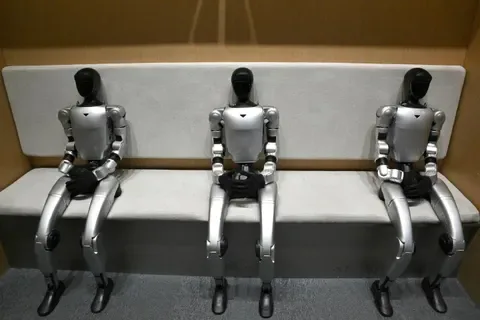
On June 1, 2026, Jensen Huang took the stage in Taipei ahead of Computex and announced that Nvidia’s first commercial humanoid robot — a nearly six-foot machine called the Isaac GR00T Reference Humanoid — would be built around hardware from China’s Unitree Robotics. The robot’s body comes from Unitree in Hangzhou, its hands from Singapore-based Sharpa, and its brain from Nvidia’s Blackwell GPU. Researchers at Stanford, ETH Zurich, and UC San Diego will be among the first to use it. The next day, Unitree received IPO approval from the Shanghai Stock Exchange in a record 73 days from application to review — a speed that China’s state media portrayed as a signal of strategic intent rather than routine capital markets activity. China Daily called the Nvidia-Unitree deal “a compelling example of how the respective industries of China and the US can leverage their unique strengths.” The unspoken message: a huge win for China in what it sees as one of the defining technology competitions of the coming decades. What We Mean by Physical AI American technologists call it physical AI. Chinese policymakers call it embodied intelligence (具身智能, jùshēn zhìnéng). The terminology is different, but the ambition is identical: giving artificial intelligence a body, so that it can perceive, reason about, and act in the physical world. The concept appeared in China’s Government Work Report for the first time in 2025 and is a centerpiece of the 15th Five-Year Plan. At GTC Taipei, Jensen declared that “today, agentic and useful AI has arrived” — and that the Isaac GR00T platform, the Jetson Thor onboard chip, and the Omniverse simulation environment are the infrastructure stack that will carry it into the physical world. Why could this matter as much, or even more than, the race for the best frontier AI model? Because digital intelligence running inside a data center, however powerful, is ultimately constrained to the digital world. Physical AI that can operate in factories, hospitals, warehouses, and homes is a labor force. And labor is the one input that has constrained economic growth and the power of empires since the beginning of recorded history. The demographic mathematics are unforgiving. South Korea’s fertility rate rebounded slightly to 0.80 in 2025 but remains the world’s lowest — putting it on track to halve in population over the next 60 years. The Bank of Korea projects the country’s economy could begin to contract as early as 2041. Japan, Germany, and China face versions of the same cliff, just at slightly different angles. No immigration policy credibly solves a problem of that scale. Humanoid robots, if the technology delivers, potentially could soften the erosion of GDP and living standards. Jensen estimates the total addressable market for physical AI at $40 trillion. That number is a vibe as much as an estimate. As I observed in my read of the SpaceX S-1, large numbers are easier to type than to earn. But the directional point is serious. This technology plays a critical role at the intersection of labor economics, supply chain control, and national security, rivaling that of generative AI. Jensen’s Strategy: The Arms Dealer Nvidia’s approach to physical AI is the same one that made it the world’s most valuable semiconductor company: build the platform, let everyone else build on top of it, and collect the compute and software tax on the entire ecosystem. The Isaac GR00T platform, the Jetson Thor onboard chip, and the Omniverse simulation environment are the infrastructure stack Jensen is betting will define how physical AI gets built — by everyone. The Unitree partnership is a near-perfect expression of that philosophy. Nvidia did not build a robot. It chose the best robot body available, regardless of where it was manufactured, installed its brain, and sold the resulting system to the world’s leading research institutions. The arms dealer doesn’t need to win the war. He needs to be indispensable to every army in it. The choice of a Chinese body was not incidental. Eight of every ten humanoid robots produced worldwide come from China. Unitree’s revenue grew 335% year-on-year in 2025. The company is, by a wide margin, the most commercially proven humanoid manufacturer on the planet. Nvidia has also been careful to signal that Unitree is not its only hardware partner. The company is pursuing similar collaborations with robot makers in the United States, Europe, and South Korea, though it has not yet named them. It has also built Blackwell’s security architecture — secure boot, confidential computing, software verification — directly into the Unitree platform, addressing at least some of the Congressional concerns about Chinese-manufactured robots in federally funded labs. The message is: we are the neutral infrastructure layer, and we are making it trustworthy. This is a delicate position to hold. Some U.S. lawmakers have called for banning Unitree products from federally funded research entirely, citing alleged ties to Chinese government programs. Multiple security researchers found serious vulnerabilities in Unitree products in 2025, including a wormable Bluetooth vulnerability. Nvidia’s arguments on security are debatable, but its commercial logic is impeccable: the arms dealer who refuses to sell to the largest army in the market is not a neutral party — he is simply irrelevant. Elon’s Strategy: The Vertical Integrator Elon Musk’s approach is the philosophical inverse. Tesla has explicitly described itself as “a physical AI company” in its SEC filings, and the Optimus robot is the embodiment of that claim — literally. Where Jensen partners horizontally across the globe, Elon seeks to build vertically within one organization. The unique asset in Tesla’s strategy is its AI stack. The FSD neural network that has now launched unsupervised robotaxi service in Dallas and Houston is the same end-to-end perception and control architecture being trained into Optimus. No other humanoid manufacturer has anything comparable — a proven, real-world autonomous intelligence system running at scale. The challenge is the hardware economics. A McKinsey analysis found that building Optimus without Chinese suppliers would cost approximately three times as much — a bill of materials surging from roughly $46,000 to $131,000. The Gen 3 Optimus is designed for mass production, with a one-million-unit-per-year line planned at Fremont, but the company acknowledged in Q1 2026 earnings that Optimus was not yet in use “in a material way” in its own factories. The distance between Elon’s production ambitions and the current reality is a gap that investors must evaluate carefully. China vs. The United States: Where Each Side Is Strong The simplest way to frame the competitive landscape is this: China dominates the body; America leads on the brain. China’s EV supply chain — motors, power electronics, battery systems, precision actuators — maps almost directly onto humanoid robot components. Chinese manufacturers have cut their bill-of-materials costs approximately 40% year-over-year. The country installed 295,000 industrial robots in 2024 alone — more than the rest of the world combined — creating the factory floor training data that humanoid developers depend on. And Beijing has committed a $138 billion state venture capital fund to AI and robotics, alongside national policy frameworks that make embodied intelligence a strategic priority through 2030. America’s advantage is in the intelligence layer. American foundation models, simulation environments, and reinforcement learning research remain unmatched. Tight integration between AI platforms and robotics — Tesla-FSD, Nvidia-Isaac, Boston Dynamics partnered with Google DeepMind — gives American robots a reasoning and generalization capability that Chinese hardware has not yet replicated. The question is whether the chip constraint materially limits China’s physical AI trajectory or simply slows it. The Brookings Institution testified to Congress in April 2026 that China’s full-stack approach to physical AI represents a strategic challenge comparable to its dominance of solar panels and EVs. This is a race between two genuinely capable industrial civilizations pursuing different strategies. China is deploying massive numbers of units into factories, spinning up the data flywheel, iterating at volume. The United States is betting that the intelligence layer is the durable moat, and that an AI-first robot will ultimately outperform a hardware-first one. The $3 Trillion Question Beneath all of this runs a corporate restructuring story that could reframe the entire competitive picture. SpaceX is set to begin trading on Nasdaq as “SPCX” on June 12, targeting a $1.75 trillion valuation in what may be the largest IPO in history. As I wrote in my deep dive into the S-1, the filing rewards careful reading. Buried in the risk factors is a sentence that has set Wall Street buzzing: SpaceX “may issue a significant amount of equity in connection with future transactions.” CNBC has reported that Elon has spoken with colleagues about potentially combining Tesla and SpaceX into a single company. Wedbush’s Dan Ives puts the odds at 80 to 90 percent by early 2027. The crowd on Polymarket is more skeptical — currently pricing the merger at roughly 43% by year-end. The strategic logic, viewed through a physical AI lens, is compelling. A combined SpaceX-Tesla would house xAI’s Grok models, Tesla’s FSD stack and Dojo supercomputer, the Optimus robot program, Starlink’s global communications infrastructure, and Terafab — the chip manufacturing joint venture with Tesla and Intel being developed in East Texas — under a single roof. That would be the most vertically integrated physical AI company ever assembled: one entity controlling the intelligence, the robot body, the chip, and the network. If Elon can assemble the empire he envisions, it is a genuine answer to Jensen’s ecosystem strategy. A single organism that makes the platform irrelevant for at least one very large customer. If the merger stalls, the production timelines slip again, or Terafab proves harder to execute than to announce — then Jensen’s arms dealer model wins by default. Who Wins? It is far too early to call a winner in the race to dominate physical AI. It’s quite possible we end up with a segmented market, not unlike the Apple-Android dichotomy that defined the mobile device world for decades — the arms dealer and the emperor each carving out dominant positions in different segments. What I will say is this: the societies that need this technology to work are not abstractions. South Korea, Japan, Germany, China, and eventually the United States all face versions of the same arithmetic — too few workers, too many retirees, too little time to solve it through conventional means. A humanoid robot that can perform factory, logistics, or care work reliably is not a luxury product. It is, potentially, the economic infrastructure of the next half-century. The robots are coming. The only real question is whose name will be on the box.
Source: Forbes