



By Stav Dimitropoulos
Jun 05, 2026
Your Consciousness Emerges From a Vast ‘Invisible’ Network, a Breakthrough Study Suggests
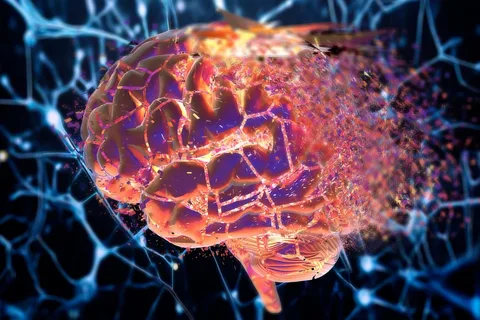
For decades, neuroscience has charted the map of consciousness. It identified neurons, mapped brain regions, and painstakingly charted which areas flare to life when you recognize a face, remember a childhood summer, or exclaim “Eureka!” after connecting two ideas. The map has grown ever more detailed, revealing new neurons, circuits, and regions with remarkable precision. But does the map tell the whole story? Can it explain not just what the brain is made of, or where its components sit, but how billions of cells organize themselves into a system capable of producing the vibrant inner mental world we call consciousness? Neuroscience has a favorite creature for tackling questions like these: the fruit fly (Drosophila melanogaster), that tiny annoying insect often found hovering over overripe bananas and forgotten kitchen scraps. Now the humble insect may be the herald of an emerging idea about how neurons generate consciousness based on an invisible geometry. Despite possessing only about 139,000 neurons—a fraction of the roughly 86 billion found in the human brain—the fruit fly is one of the few creatures whose connectome scientists have mapped in extraordinary detail. The connectome is the vast network of roads, bridges, and highways linking neurons together. A new study suggests that even this meticulously reconstructed brain map may not tell the whole story. In a February 2026 preprint posted to arXiv, researchers at Eötvös Loránd University in Budapest did something counterintuitive. Rather than focusing on where the fly’s neurons physically sit, they examined how those neurons connect to one another. The team then projected the network into hyperbolic space, a curved geometry with what mathematicians call “negative curvature.” Mainstream Euclidean geometry, the geometry most of us learned in school, describes the familiar world of rulers, grids, straight lines, and ordinary three-dimensional coordinates. Hyperbolic geometry, by contrast, bends away from the straight lines and orderly grids of Euclidean space. As you move away from the center, space expands much more rapidly, creating room for sprawling networks, branching hierarchies, and highly connected hubs. Because many real-world systems—from brains and ecosystems to social networks and the internet—share these features, researchers increasingly use hyperbolic geometry to uncover what some call the “hidden geometry” of complex systems: the deeper organizational blueprint that governs how a network behaves, even when that blueprint’s physical structure remains invisible. “In a standard 3D Euclidean representation, the physical layout is visually crowded, obscuring how signals actually navigate through the system,” says Bendegúz Sulyok, a network science researcher at Eötvös Loránd University in Budapest, and one of the study’s authors. By turning to a negatively curved mathematical space, in which space expands rapidly away from a central point, his team observed striking patterns in the fly’s connectome. They saw that neurons that serve as major communication hubs clustered near the center, while more specialized cells responsible for particular functions drifted toward the edge, even when they were physically far apart in the actual brain. It’s complicated, but essentially, neurons that do similar jobs end up pointing in roughly the same direction, Sulyok says. For example, major groups such as optic neurons, which help the fly spot a piece of watermelon from across the room, and central neurons, which help coordinate information from across the brain as it decides how to dodge a swatting hand, separated into distinct sectors of the map. Yet even if the hyperbolic map reveals relationships, groupings, and patterns that remain hidden in the flat wiring diagram, a bigger question remains. Does this hidden geometry reflect something fundamental about how brains organize themselves—and perhaps even about consciousness itself—or is it merely a clever mathematical visualization with little relevance outside the lab? “It is both,” says Sulyok. “It is a highly sophisticated mathematical lens, but one that tracks a fundamental biological reality.” The brain’s circuitry naturally resembles a sprawling banyan tree, with axons and dendrites, the cable-like extensions of neurons, repeatedly splitting and spreading outward to form vast neural matrices. Hyperbolic geometry, Sulyok argues, provides a particularly natural way to represent these hierarchies. To investigate the idea, the team applied a battery of mathematical tests intended to see whether the invisible design genuinely mirrored how the brain organizes itself beneath the surface. Time and again, they outperformed conventional low-dimensional maps, suggesting that this alternative geometrical framework isn’t just a clever visualization trick. A fruit fly is not a human, you might object. But you may be overlooking an important feature of nature: Everything from labyrinthine neural networks and ecosystems to the brain of an insect tends to organize itself around clusters, hubs, and subnetworks that must somehow communicate with one another. If those systems share a kind of invisible code underlying their organization, then its clearest manifestation may be hyperbolic geometry. And if this staggering amount of connectivity happens inside a speck-sized nervous system, imagine the challenge facing the human brain. Sulyok suspects the fly may simply be the first place we noticed the pattern. “We expect that our results will stand for human brains as well,” he says. That alone raises an intriguing possibility. In our quest to understand consciousness, have we obsessed over visible anatomy while overlooking something deeper—the invisible web of connections that emerges when billions of neurons begin acting as one? The question points to a broader trend in neuroscience. Increasingly, researchers are moving beyond asking what each brain region does and toward a more elusive question: Does cognition, awareness—and perhaps consciousness itself—reside in the brain’s individual parts or in the exchanges between them? Theoretical neuroscientist and psychiatrist Karl Friston sees the brain as a prediction machine, continuously constructing models of reality and updating them on the fly. Olaf Sporns, the pioneer behind network neuroscience, views the brain less as a set of neatly labeled compartments and more as a tangled web of connections. And consciousness researcher Giulio Tononi believes that awareness depends not simply on neurons firing, but on how countless signals come together to form a unified experience of reality. The idea also resonates with Ramses Alcaide, PhD, a neuroscientist and CEO of the neurotechnology company Neurable. For decades, he says, the approach of dividing the brain into regions and assigning functions to them produced important insights, but it may not tell the whole story. As Alcaide puts it, cognition lives in the flow, not the location. “Anatomy tells you where things are. Network geometry tells you how information actually flows... The wires tell you what can connect. They do not tell you why certain patterns of connection produce thought, attention, or awareness.” From Alcaide’s perspective, one of the study’s most intriguing suggestions is that the brain’s anatomical map might be incomplete as an explanation of cognition. “Cognition and possibly consciousness may be properties of that deeper organization,” he says. The possibility that our most cherished mental phenomena may arise within a deeper and largely invisible mathematical landscape with no physical counterpart is, in his view, nothing short of a genuinely profound implication. But, if that is true, we may need to rethink the very tools we use to study the mind. “If that is true in a fly, and if the principle generalizes to larger brains, then we have been reading the wrong map,” Alcaide says. “The next frontier may lie not in discovering new brain regions, but in learning to read the hidden source code that transforms billions of cells into a conscious experience.” Sulyok, one of the study’s authors, strikes a more cautious note. He doesn’t necessarily disagree with the broader implications, but consciousness, he stresses, lies well beyond what the study set out to test: the structure of the neural network, not the origins of awareness itself. Yet he repeatedly returns to the possibility that the fly may be revealing a strategy that nature reuses across brains of vastly different sizes. “We know the human brain network to exhibit modular and hierarchical features—not unlike the fly’s brain—features that are consistent with hyperbolic geometry,” he says. Whether that resemblance ultimately proves important for consciousness remains unknown. What is certain is that—unlikely as it may seem—the mind of the fly circling your watermelon this summer may hide clues to understanding your own.
Source: Yahoo